
Table of Contents
ToggleHow to Build a Digital Marketing Strategy for 2026
By 2026, digital marketing will not be about who posts the most or who adopts the newest tool first.It will be about who earns attention, trust, and repeat business in a world where people are overwhelmed by content. I work closely with local service brands and real estate businesses, and one thing is already clear today:
Attention is cheap. Qualified attention is rare.
A winning digital marketing strategy for 2026 must be designed around buyer decision-making, not platform trends. Below is a practical, field-tested framework you can adapt whether you’re a real estate consultant, agency owner, local business, or growing brand.

Step 1: Start With Business Reality, Not Marketing Hype
Most marketing plans fail before execution because they start with platforms:
Should we do Instagram?
Instagram works when your audience spends time there and visuals help explain or build trust around your offer. If it supports brand visibility or demand generation, it’s worth doing.
Should we try YouTube?
YouTube is effective if your buyers research, compare, or learn before purchasing. Educational and problem-solving videos build authority and influence long buying decisions.
What I Do First
I define the business truth:
How does money actually come in?
Revenue comes in when a real business problem is solved and trust is built through proof, clarity, and outcomes. Buyers pay for results, reliability, and reduced risk—not features alone.
How long is the buying cycle?
The buying cycle depends on urgency, price, and complexity, ranging from days for low-risk services to months for high-value decisions. Clear messaging and credibility shorten decision time.
Who influences the final decision?
Final decisions are influenced by decision-makers, budget holders, and trusted advisors who validate risk and ROI. Reviews, case studies, and peer recommendations carry strong weight.
What causes deals to stall or die?
Deals stall when value is unclear, trust is missing, or next steps aren’t defined. Budget concerns, internal delays, and poor follow-up often kill momentum.
Example
A builder wanted more Instagram views.The real problem? Buyers didn’t trust delivery timelines.
The strategy shifted from “more reels” to:
- Long-form explanation content
- Past project walkthroughs
- Clear timelines and process breakdowns
2026 Rule
Your strategy must begin with:
- Revenue targets
- Conversion bottlenecks
- Retention opportunities
Read More: 11 Best Cost-Effective Digital Marketing Strategies 2026

Step 2: Redesign Content Around Buyer Intent, Not Algorithms
In 2026, content volume will increase. But decision-stage content will stay scarce.
How Buyers Consume Content Now
- Short content = discovery
- Long content = validation
- Repeated exposure = trust
Practical Content Framework I Use
1. Attention Content
Short videos, carousels, snippets
Purpose: “I exist”
2. Clarification Content
Short videos, carousels, snippets
Purpose: “I exist”
3. Decision Content
Case studies, walkthroughs, breakdowns
Purpose: “I’m safe to choose”

Step 3: Use AI Aggressively — But Never Unfiltered
AI will be unavoidable in 2026. The mistake is letting it speak for your brand.
How I Actually Use AI
- Research synthesis
- First-draft outlines
- Ad variation testing
- Data pattern detection
Where Humans Must Stay In Control
- Tone
- Opinion
- Local nuance
- Risk statements
- Authority positioning
Real-World Lesson
AI-written real estate ads often promise too much. That attracts low-quality leads and legal risk.
Human editing prevents:
- Overpromising
- Generic messaging
- Trust erosion

Step 4: Build an Owned Audience Before You Need It
Followers are rented. Communities are owned. This matters more than ever for local and high-ticket businesses.
Platforms I’ve Seen Work Best
- WhatsApp Broadcasts (India especially)
- Telegram channels
- Email (still underrated)
- Private buyer groups
Why This Wins in 2026
- Algorithms can’t throttle it
- Buyers feel insider access
- Conversion costs drop over time
Example
A local property consultant built a WhatsApp list of 600 serious buyers.
Every launch:
- Zero ad spend
- Faster inventory movement
- Higher negotiation power
Step 5: Treat Search as Multi-Platform, Not Just Google
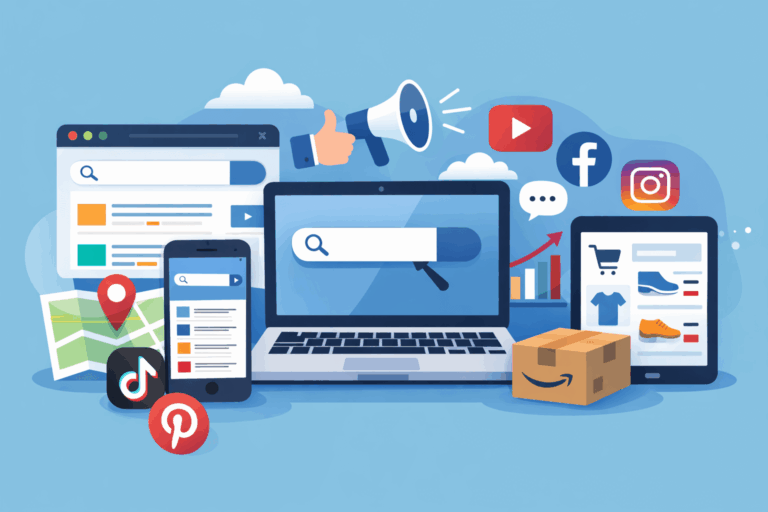
By 2026, people will search on:
High-intent platform where buyers actively search to solve a problem. Works best for demand capture, leads, and conversion-focused visibility.
YouTube
Research-driven channel ideal for education, trust-building, and long buying cycles. Buyers use it to compare options and validate decisions.
Discovery and brand-building platform that influences awareness and recall. Best for visual storytelling, social proof, and staying top-of-mind
Marketplaces
Used when buyers want fast comparison, pricing clarity, and reduced risk. Reviews, ratings, and positioning strongly impact decisions.
Practical Shift
Every piece of content should answer:
What would someone search to find this?
They search using problem-based, intent-driven queries that describe their pain, need, or desired outcome. Clear alignment with real search language ensures you show up at the right moment.
What problem does this solve?
It solves a specific business or user pain by reducing effort, risk, or confusion. If the problem isn’t obvious, the offer won’t convert.
Personalization works — until it feels creepy.
What I Recommend
- Use clear titles everywhere
- Speak problems out loud in videos
- Add transcripts and captions
- Build “how” and “comparison” content

Step 6: Personalization Without Crossing Trust Lines
Personalization works — until it feels creepy.
In 2026, buyers will reward brands that:
Explain why they’re seeing something
Tell users clearly why they’re being shown content or ads to build trust and transparency. Relevance increases when intent and context are explained.
Respect boundaries
Avoid over-targeting or intrusive tactics that feel invasive. Permission-based, user-first marketing protects brand credibility.
Use data responsibly
Collect and use only necessary data with clear consent and purpose. Ethical data use strengthens long-term trust and compliance.
Smart Personalization That Converts
- Location-based messaging
- Stage-based follow-ups
- Behavior-driven content (not stalking)

Step 7: Experiment — But Only With a Clear Learning Goal
AR, interactive ads, immersive formats — yes, they matter. But most businesses fail because they experiment without intent.
My Rule
- One experiment at a time.
- One success metric.
- One learning outcome.
Example:
Instead of “Let’s try AR”
Test:
Does virtual site walkthrough reduce physical visit drop-offs?
Yes — virtual site walkthroughs generally reduce physical visit drop-offs because they help people decide before they show up in person. Virtual tours give a realistic, interactive view of a space, so only genuinely interested visitors schedule physical visits, cutting down wasted trips and no-shows.

Sample Budget Framework
Based on what I’ve seen work consistently:
- 35% – Content & authority (short + deep)
- 30% – Performance & discovery (search + paid)
- 15% – CRM, automation, data
- 10% – Community & retention
- 10% – Controlled experiments
Case Study Snapshot
Problem:
High traffic, low conversions.
Changes:
- Reduced content volume
- Added decision-stage explainers
- Built WhatsApp follow-up system
- Human-edited AI drafts
Result (90 days):
- Fewer leads
- 2× close rate
- Lower ad dependency
Conclusion
The strongest digital marketing strategies in 2026 will not be built on shortcuts, hacks, or louder messaging. They will be built on respect—respect for how buyers think, how they decide, and how much information they already have access to. Today’s buyers are more informed than ever. They compare options, read reviews, consult AI assistants, and validate claims across multiple platforms before they ever speak to a business. Strategies that underestimate this intelligence will lose trust before they ever win attention.
Respecting buyer intelligence means simplifying, not overselling. It means presenting clear value, honest positioning, and real proof instead of inflated promises. When brands focus on reducing confusion—by answering the right questions at the right time—they remove friction from the buying journey. Clear messaging, structured content, and transparent offers help buyers move forward with confidence rather than hesitation. Confusion doesn’t slow decisions; it kills them.
How to Build a Digital Marketing Strategy - FAQs
Q1. Is digital marketing more expensive in 2026?
Q2. Should small local businesses use AI?
Q3. Is social media still necessary?
Q4. What’s the biggest mistake brands will make in 2026?
Q5. How long before results show?
References
- Google Search Central & Ads documentation
- HubSpot & Gartner marketing trend reports
- Meta & Google platform updates
- First-hand campaign execution across real estate, services, and local brands
- Buyer behavior insights from on-ground sales conversations


