
Table of Contents
ToggleHow content marketing builds brand authority?
In crowded markets, attention is expensive and trust is rare. Ads may generate clicks, but authority earns loyalty, referrals, and premium pricing.
After working with B2B service brands, SaaS startups, and local businesses over the last decade, I’ve noticed one consistent truth:
Companies that invest in strategic content marketing dominate long-term visibility and buyer trust — even with smaller budgets.
This guide breaks down how content marketing builds brand authority, with step-by-step execution, real-world examples, and practical insights you can implement immediately.

What Is Brand Authority — And Why It Actually Matters
Brand authority isn’t about being popular. It’s about being trusted, referenced, and preferred.
An authoritative brand:
- Gets cited by others
- Ranks consistently on Google
- Is trusted before the sales call
- Faces less price resistance
- Wins deals faster
Authority reduces friction in the buyer journey. Instead of convincing people why you’re credible, your content already does that.
Read More:- Why Brand Authority Matters More than Rankings?

Why Content Marketing Is the Most Sustainable Authority Builder
Unlike paid ads (which stop when budgets stop), content compounds.
Here’s what strategic content does over time:
Builds organic visibility through SEO
Strategic content marketing improves keyword rankings, attracts consistent search traffic, and increases your brand’s visibility on search engines. Over time, this organic presence compounds, positioning your business as a trusted authority in your niche.
Positions your brand as an educator
Content marketing positions your brand as an educator by consistently sharing valuable insights, practical solutions, and expert guidance that help your audience make informed decisions. Over time, this builds trust and establishes your authority in the industry.
Answers buyer objections before sales conversations
Strategic content addresses common buyer concerns—like pricing, ROI, timelines, and risks—before they even speak to sales. This reduces hesitation, builds trust early, and shortens the decision-making process.
Creates shareable assets others reference
Creating shareable assets like original research, in-depth guides, and actionable frameworks encourages others to reference and link to your content. This increases brand visibility, backlinks, and perceived authority in your industry.
Establishes thought leadership
Establishes thought leadership by consistently sharing original insights, expert opinions, and forward-thinking ideas that position your brand as a trusted industry authority rather than just a service provider.
In my experience, brands that publish consistent, value-driven content for 12–18 months see:
- Lower cost per lead
- Higher conversion rates
- Stronger inbound inquiries
- Improved sales cycle velocity
Authority doesn’t happen overnight. But when it compounds, it becomes a moat competitors struggle to break.

7 Strategic Ways Content Marketing Builds Brand Authority
1. It Demonstrates Expertise (Instead of Claiming It)
Content marketing proves your expertise by solving real problems with depth, clarity, and practical insights—rather than just stating you’re an expert. Valuable, experience-driven content builds credibility naturally over time.
Anyone can write “We are industry experts.”
Very few can prove it.
Authority content shows:
- Deep industry understanding
- Nuanced solutions
- Real-world application
- Data-backed insights
Practical Tip:
Create “problem-aware” content — not generic advice.
Instead of:
“How to improve SEO”
Write:
“Why Your SEO Traffic Dropped After a Google Core Update (And How to Recover in 30 Days)”
Depth builds trust.
2. It Answers High-Intent Buyer Questions
When your content directly addresses pricing, processes, comparisons, and common objections, it removes buyer uncertainty and builds trust before the sales conversation even begins.
Buyers today research heavily before contacting sales.
If your content:
Explains pricing models
Content that explains pricing models clearly breaks down costs, deliverables, and value so buyers understand exactly what they’re paying for. This transparency reduces objections and builds trust before the sales conversation even begins.
Breaks down service processes
Clearly explains how your service works step-by-step, so prospects understand what to expect at every stage. This reduces uncertainty and builds trust before the sales conversation even begins.
Compares alternatives
Content that compares alternatives helps buyers evaluate options clearly, reducing confusion and positioning your brand as transparent, trustworthy, and solution-focused.
Addresses risks
Authority-building content openly discusses potential challenges, limitations, and uncertainties so buyers feel informed and confident instead of surprised later in the decision process.
You remove uncertainty.
Real Buyer Concern Example:
In B2B services, buyers often fear:
Hidden costs
Hidden costs are unexpected expenses that appear after an agreement is signed, often due to unclear pricing or scope gaps. They create distrust and can significantly increase the total investment beyond the initial quote.
Poor communication
Poor communication refers to unclear messaging, delayed responses, or lack of transparency that creates confusion and mistrust. In business relationships, it often leads to missed expectations, frustration, and weakened credibility.
Overpromising agencies
Overpromising agencies are service providers that make unrealistic guarantees about results, timelines, or ROI to win clients, often leading to disappointment, wasted budgets, and broken trust when outcomes don’t match expectations.
Lack of measurable ROI
Lack of measurable ROI refers to the inability to clearly track and prove the financial return generated from marketing efforts. Without defined KPIs and analytics, businesses struggle to justify investment and optimize performance.
Create content that directly addresses these concerns:
- “How We Structure Transparent Pricing”
- “What Happens in the First 90 Days of Working With Us”
- “How We Report ROI (With Sample Dashboard)”
Transparency builds authority.
3. It Improves Search Visibility (SEO Authority)
Strategic content marketing improves search visibility by building topical authority, earning backlinks, and targeting high-intent keywords. Over time, this strengthens your SEO authority and helps your brand rank consistently on search engines.
Search engines reward:
Topical depth
Topical depth refers to how thoroughly and comprehensively a website covers a specific subject. It shows search engines and users that your brand has deep expertise, not just surface-level knowledge.
Content clusters
Content clusters are a strategic SEO structure where one comprehensive pillar page is supported by multiple related articles, all internally linked to build topical authority and improve search rankings.
Backlinks
Backlinks are links from other websites pointing to your site, signaling credibility and trust to search engines. High-quality backlinks improve SEO rankings and strengthen your brand authority online.
Engagement signals
Engagement signals are user behavior metrics like time on page, click-through rate, comments, and shares that indicate how valuable and relevant your content is to the audience and search engines.
When you create comprehensive resources, you:
- Rank for multiple keywords
- Become the go-to reference page
Earn backlinks organically
Step-by-Step SEO Authority Model:
- Identify core topics in your industry
- Create pillar content (2,000–3,000 words)
- Build supporting cluster articles
- Interlink strategically
- Update quarterly
Authority isn’t one article. It’s structured coverage.
4. It Builds Psychological Credibility
Content builds psychological credibility by creating familiarity and perceived expertise through consistent, value-driven insights. When audiences repeatedly learn from you, trust forms naturally—even before direct interaction.
Authority isn’t only logical — it’s psychological.
Content builds:
- Familiarity
- Repetition
- Perceived expertise
- Professional positioning
When someone consumes:
- 3 blog posts
- 1 case study
- 2 LinkedIn posts
They already trust you before contacting you.
I’ve seen inbound leads say:
“We’ve been following your content for months.”
That’s authority in action.
5. It Showcases Proof Through Case Studies
Case studies build brand authority by showing real results, measurable outcomes, and practical execution—proving your expertise instead of just claiming it.
Opinion builds interest.
Proof builds authority.
What Makes a Powerful Case Study?
- Clear starting problem
- Specific metrics
- Tactical breakdown
- Timeline
- Honest challenges
Example Structure:
Client: B2B SaaS Startup
Problem: Low organic visibility, high CAC
Action: SEO-driven content cluster strategy
Result: 210% traffic increase in 9 months
Impact: 38% reduction in paid ad dependency
Specificity = credibility.
6. It Strengthens E-E-A-T Signals
Content marketing strengthens E-E-A-T (Experience, Expertise, Authoritativeness, and Trustworthiness) by showcasing real insights, proven results, credible sources, and transparent expertise. This helps both users and search engines recognize your brand as a reliable industry authority.
Google prioritizes:
- Experience
- Expertise
- Authoritativeness
- Trustworthiness
To strengthen these:
- Add author bios with real experience
- Cite credible industry sources
- Include data and research
- Publish original insights
- Add client logos and testimonials
Authority is both human and algorithmic
7. It Enables Thought Leadership Positioning
It enables brands to go beyond education and shape industry conversations by sharing original insights, bold perspectives, and future-focused ideas. Thought leadership positions your business as a trusted voice people follow—not just a service provider they hire.
Authority leaders don’t just educate.
They shape conversations.
Examples:
- Predicting industry trends
- Challenging outdated practices
- Publishing original frameworks
- Sharing real performance data
Instead of repeating common advice, create proprietary insights:
“The 3-Layer Authority Framework for Service Brands”
Awareness → Trust → Proof → Conversion
When people reference your framework, authority grows exponentially.
Read More:- How to Build Local Online Authority Quickly ?
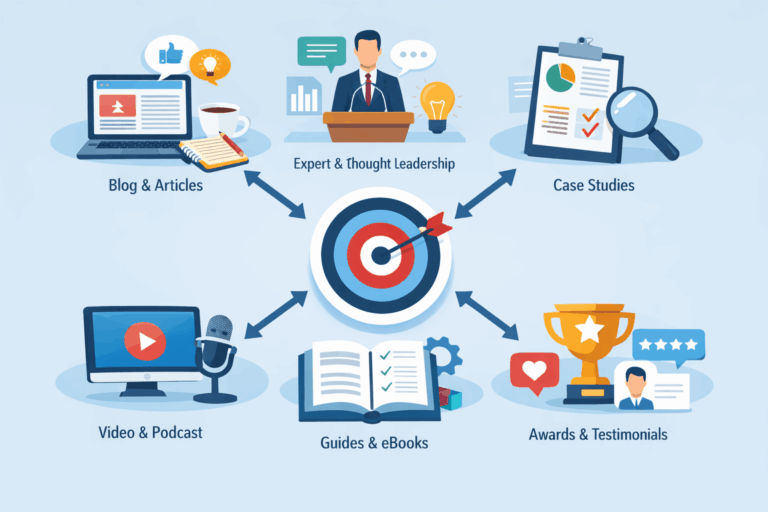
Content Types That Build Brand Authority (Ranked by Impact)
1. In-Depth Guides
Comprehensive, research-backed content that fully covers a topic, answers buyer questions, and positions your brand as a go-to authority in your industry.
2. Case Studies
Case studies showcase real client results, highlighting specific challenges, strategies implemented, and measurable outcomes to build trust and demonstrate proven expertise.
3. Comparison Content
Comparison content (like “X vs Y” or “Best A for B”) helps buyers evaluate options by clearly outlining differences, pros, cons, pricing, and use cases—building trust while targeting high-intent search traffic.
4. Data Reports
Original data reports showcase industry insights, trends, and performance benchmarks, positioning your brand as a primary source of credible, research-backed authority.
5. Strategic LinkedIn Content
Strategic LinkedIn Content focuses on sharing industry insights, real experiences, and problem-solving posts that position you as a thought leader while building trust with decision-makers and high-intent prospects.

A Step-by-Step Authority Content Plan (90-Day Framework)
Month 1: Foundation
- Define positioning
- Identify 10 high-intent keywords
- Publish 3 pillar articles
- Create 1 detailed case study
Month 2: Expansion
- Publish 6 cluster posts
- Start LinkedIn authority content
- Add internal linking strategy
- Improve on-page optimization
Month 3: Amplification
- Outreach for backlinks
- Repurpose content into:
- Carousels
- Short videos
- Email newsletters
- Carousels
- Publish one “opinion-based” thought leadership piece
Consistency > volume.
Common Mistakes That Destroy Authority
- Publishing generic content
- Writing only for keywords, not users
- Ignoring real buyer objections
- No case studies
- No author credibility
- Inconsistent publishing
Authority requires clarity and patience.

Measuring Brand Authority Growth
Authority is measurable.
Track:
- Organic traffic growth
- Branded search volume
- Backlink profile strength
- Engagement time
- Lead quality
- Sales cycle length
One strong sign of authority:
Inbound leads saying, “We already know what you do.”

Advanced Authority Strategy Most Brands Miss
1. Create “Objection Content”
Creating “Objection Content” means proactively addressing your buyers’ toughest questions, doubts, and hesitations through transparent, value-driven content—so trust is built before the sales conversation even begins.
2. Publish Pricing Transparency
Clearly sharing your pricing structure, packages, or cost ranges builds instant trust, filters unqualified leads, and reduces friction in the buyer’s decision-making process.
3. Build Topic Domination Instead of Scattered Posts
Instead of publishing random blogs on multiple topics, focus on deeply covering one niche with pillar content and supporting cluster articles. This structured approach builds topical authority, improves SEO rankings, and positions your brand as the go-to expert in that space.
4. Leverage Founder Voice
When founders share real experiences, lessons, and opinions through content, it humanizes the brand and builds stronger trust. People connect with authentic voices more than corporate messaging.
Conclusion
Content marketing isn’t about traffic.
It’s about positioning.
The brands that win:
- Educate deeply
- Share real results
- Address real problems
- Stay consistent
- Think long-term
Authority lowers acquisition costs, increases deal sizes, and builds defensibility.
If your goal is short-term leads, run ads.
If your goal is market leadership, build authority through content.
And remember:
Authority isn’t built by talking about yourself.
It’s built by solving real problems better than anyone else — consistently.
How content marketing builds brand authority: FAQs
Brand authority typically takes 6–12 months of consistent, high-quality publishing. However, early signals like improved engagement, backlinks, and lead quality can appear within 3–4 months if the strategy is structured correctly.
In-depth guides, data-backed case studies, and comparison articles (“X vs Y”) build authority fastest because they target high-intent users and demonstrate real expertise instead of generic advice.
Yes. In fact, niche-focused small businesses often build authority faster than large brands by publishing specialized, problem-solving content that directly addresses specific buyer pain points.
Content builds trust by educating prospects before they speak to sales, addressing objections transparently, showcasing proof through case studies, and demonstrating consistent expertise over time.
Track organic traffic growth, branded search volume, backlinks, average session duration, inbound lead quality, and shorter sales cycles. Increasing direct inquiries referencing your content is a strong authority indicator.


