
Table of Contents
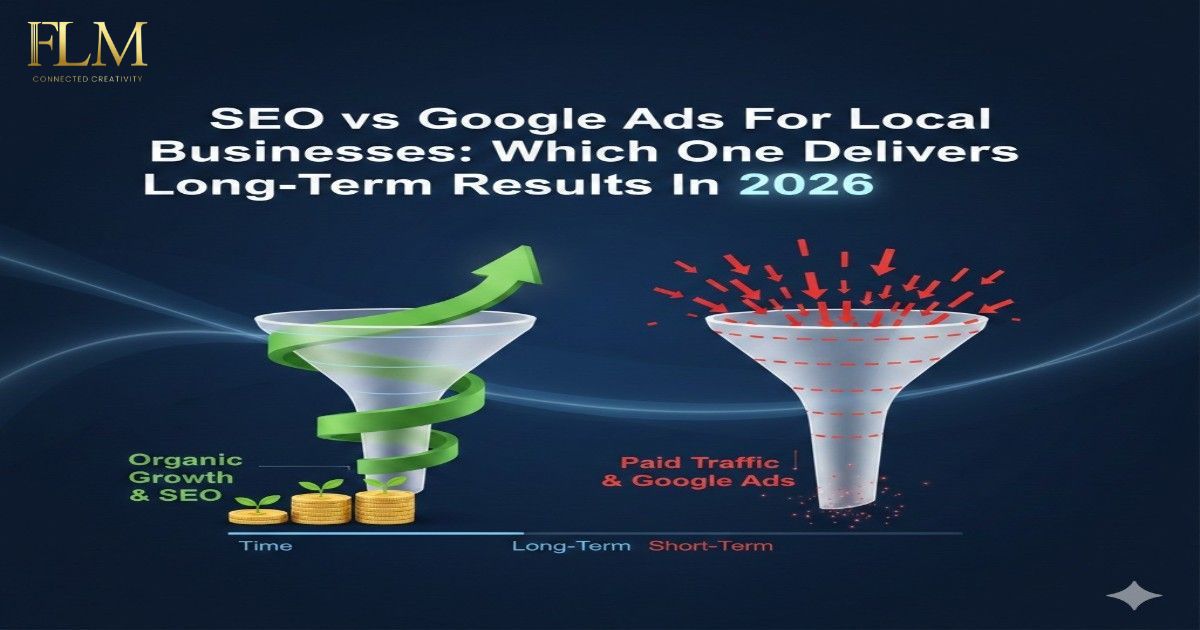
ToggleSEO vs Google Ads For Local Businesses: Which One Delivers Long-Term Results In 2026
A plumbing company in Ahmedabad came to me in late 2025. They were spending ₹1,20,000/month on Google Ads. Leads looked “good” in reports. The agency said: “We should also start SEO. Competitors are doing both.”
Owner’s reality:
- Cash flow is tight.
- CPC is rising every quarter.
- No clarity on which leads are converted.
- Fear of wasting ₹50,000–₹2,00,000/month.
- No long-term plan.
They weren’t asking, “Which is better?” They were asking, “How do I stop burning money?”
Most blogs comparing SEO vs PPC fail because:
- They oversimplify: “SEO = long term, Ads = short term.”
- They ignore the business stage and survival pressure.
- They don’t discuss CAC, LTV, or cash flow.
- They’re written to rank, not to guide.
In my experience, auditing ad accounts and SEO campaigns for local service businesses in 2024–2026:Most businesses don’t have a channel problem. They have a decision-timing problem.
This guide will help you avoid the wrong decision at the wrong time.
REAL BUSINESS PROBLEMS
Problem 1: Agencies Push Ads Because Numbers Look Fast
Google Ads shows:
- Clicks
- Impressions
- Leads
That creates psychological comfort. But I’ve audited accounts where:
- 40–60% of “leads” were junk.
- No offline conversion tracking.
- No cost-per-sale clarity.
How this helps you: If you don’t know the cost per closed deal, Ads can become a silent cash drain.
Problem 2: SEO Agencies Promise Rankings, Not Revenue
Common pattern:
- “We’ll rank you in 6 months.”
- No conversation about keyword intent.
- No talk about conversion tracking.
I’ve seen businesses rank #1 and still struggle because:
- Wrong keywords.
- No call tracking.
- Poor website UX.
Avoid this mistake: SEO traffic without conversion infrastructure is vanity.
Problem 3: CPC Inflation in 2026 Is Real
Across competitive Indian cities:
- Legal, medical, home services CPCs have increased 25–60% since 2023.
- AI bidding automation increased competition.
- Smaller players are squeezed.
Problem 4: SEO Takes 6–12 Months (And There Are No Guarantees)
- New domain?
- Competitive niche?
- Weak backlink profile?
Expect 8–12 months minimum for meaningful revenue impact.
If your business needs leads to survive next month, SEO alone can be dangerous.
Problem 5: Budget Spread Too Thin
I’ve seen:
- ₹40k Ads
- ₹30k SEO
- ₹20k Social
- ₹10k Random “branding”
Result? Nothing works properly.
Underfunded channels rarely perform.
New vs Established Businesses
| Business Type | Better First Move |
|---|---|
| New, cash tight | Ads (controlled testing) |
| Established, stable | SEO + selective Ads |
| Scaling multi-location | Hybrid, data-driven |
| Low margins | SEO-first |
STEP-BY-STEP DECISION FRAMEWORK
Step 1: Business Stage & Cash Flow Reality
What to do:
Ask:
- Do I need leads in 30 days to survive?
- What’s my monthly marketing capacity for 6 months?
Why it matters:
SEO doesn’t pay rent immediately.
Mistake to avoid:
Starting SEO when a business cannot survive 6 months without returns.
Pro tip:
If you’re new, use Ads to validate:
- Keywords
- Offers
- Pricing
Step 2: Market Competition & CPC Analysis
What to do:
Average CPC
Average CPC (Cost Per Click) is the amount you pay each time someone clicks on your Google Ad. A higher CPC usually indicates strong competition in your market and can reduce your profit margins quickly if your conversion rate is low. It’s important to compare CPC with your actual cost per closed deal, not just cost per lead, to understand real profitability.
Search Volume
Search volume refers to how many people search for a particular keyword each month. High search volume shows strong demand but often comes with intense competition. Lower volume keywords can still generate quality leads if they have strong buying intent. The goal is not just traffic, but relevant traffic that converts.
Competitor Ad Density
Competitor ad density shows how many businesses are bidding on the same keyword. When many competitors run ads, CPC tends to rise due to aggressive bidding. If large brands dominate top ad positions, smaller businesses may struggle with rising costs. This metric helps you understand how competitive and expensive your ad environment will be.
Organic Ranking Difficulty
Organic ranking difficulty indicates how hard it is to rank on the first page of Google through SEO. If top results are established websites with strong backlink profiles and years of authority, ranking will take more time and effort. New businesses especially face challenges in competitive niches. Evaluating difficulty helps set realistic expectations for SEO timelines.
When Ads become too expensive:
If CPC × close rate > acceptable CAC.
When SEO becomes unrealistic:
If top 5 results are:
- 10+ year domains
- Heavy authority sites
- Massive backlink profiles
Pro Tip:
Use Ads data to find “profitable pockets” for SEO content strategy.
Step 3: Long-Term ROI Comparison (2026 Reality)
Example scenario: Monthly budget: ₹1,00,000
Google Ads (6 months)
- Spend: ₹6,00,000
- Avg CPL: ₹1,200
- Leads: 500
- Close rate: 15%
- Customers: 75
CAC ≈ ₹8,000
SEO (6 months)
- Spend: ₹4,50,000
- Low leads first 3 months
- Month 6 onward compounding
- Customers after 6 months: 30–50
Risk Factors
But month 12:
- SEO cost stable
- Leads increase without per-click cost
| Channel | Risk |
|---|---|
| Ads | CPC rise, account suspension |
| SEO | Algorithm update volatility |
| Both | Poor tracking = blind decisions |
Step 4: Budget Allocation Strategy
Go 70% Ads / 30% SEO When:
- You’re new.
- Need fast validation.
- Strong margins.
Go 100% SEO When:
- CPC is too high.
- Long-term brand focus.
- Stable cash flow.
Go 100% Ads When:
- Short-term seasonal push.
- Testing a new market.
Do Neither When:
- No tracking.
- Weak website.
- Poor service quality.
Step 5: Agency & Freelancer Evaluation
Red Flags (Ads):
- Reporting clicks, not revenue.
- No conversion tracking.
- No offline sales tracking.
Red Flags (SEO):
- “Guaranteed ranking.”
- No keyword intent discussion.
- No Search Console access.
Verify using:
- Google Ads dashboard
- Google Analytics conversion reports
- Google Search Console data
Step 6: Optimization & Scaling Decisions
When to reduce Ads:
Organic traffic converting well.
Organic traffic converting well means your SEO visitors are not just browsing but actually taking action — calling, filling forms, or purchasing. This indicates strong keyword targeting and good intent alignment, making it safer to gradually reduce ad dependency.
Branded search growing
Branded search growing means more people are directly searching for your business name on Google. This usually signals increasing brand awareness and trust. When branded search rises consistently, it often reflects successful long-term SEO and customer experience efforts.
When to scale Ads:
Proven CAC below LTV
Proven CAC below LTV means your Customer Acquisition Cost is consistently lower than the Lifetime Value of a customer. In simple terms, you’re spending less to acquire a customer than the total revenue that customer generates over time. This is the foundation of sustainable scaling — without this gap, increasing the budget only increases losses.
Strong conversion tracking
Strong conversion tracking means you can clearly trace which clicks turn into real revenue, not just leads. This includes proper call tracking, form tracking, and offline sales attribution. Without reliable tracking, scaling ads or SEO becomes guesswork, and decisions are based on assumptions instead of data.
Read More:- Local SEO vs Google Ads: Which Gives Better ROI?
REAL CASE STUDIES
Case 1: Small Local Home Service Business
- Industry: Pest Control
- City: Tier-2
- Budget: ₹70,000/month
- Initial choice: 100% Google Ads
6-month results:
- Avg CPL: ₹900
- Close rate: 12%
- CAC: ₹7,500
- Margins tight.
What failed:
- No retargeting.
- No SEO content.
Correction:
- Shifted 30% to SEO.
- Created service pages for high-intent keywords.
12-month result:
- Organic leads 40% of total.
- Blended CAC dropped to ₹5,800.
Case 2: Multi-Location Physiotherapy Brand
- Budget: ₹2,50,000/month
- Strategy: 60% Ads, 40% SEO
- Initial CAC: ₹6,200
- Break-even: Month 8
Scaling mistake:
Increased ad budget without improving landing pages.
Course correction:
- CRO improvements.
- Local SEO per branch.
Final:
- CAC reduced to ₹4,900
- Organic contributed 55% of new leads after 14 months.

TESTIMONIALS
“We were burning ₹1.5 lakh on Ads. Once we tracked actual closed jobs, we realized half the leads were junk. Fixing tracking changed everything.”
— Rohit Sharma, Founder – Local Repair Service
“SEO felt slow and frustrating. But month 9 onward, we saw stable patient flow without increasing ad budget.”
— Dr. Neha Mehta, Marketing Head – Multi-location Clinic
“We tried both randomly. Nothing worked. Once we stopped spreading budget thin and focused on one goal, results stabilized.”
— Amit Patel, Retail Store Owner

2026 MARKET CONTEXT
Observed from dashboards and benchmarks:
CPC inflation continues in competitive niches.
CPC inflation continues in competitive niches, especially in industries like healthcare, legal services, and home repairs. As more advertisers enter the auction and automation tools optimize bids aggressively, the average cost per click keeps rising. If margins are tight, this inflation can quietly erode profitability over time.
AI-driven Smart Bidding increases competition.
AI-driven Smart Bidding increases competition because platforms automatically adjust bids in real time to win high-intent users. While this improves efficiency for well-structured accounts, it also raises auction pressure for smaller advertisers. Businesses without strong tracking and historical data often struggle to compete effectively.
SEO volatility due to algorithm updates
SEO volatility due to algorithm updates remains a real concern. Search engines frequently adjust ranking factors to improve content quality and user experience. Websites that rely heavily on one traffic source or outdated tactics may see sudden ranking drops, which is why partnering with a professional digital marketing company can help businesses adapt to changes with strategic, data-driven SEO practices. Long-term SEO now requires consistent quality, authority, and technical stability.
Platform dependency risk is real
Platform dependency risk is real when a business relies entirely on either Ads or organic traffic. An ad account suspension, policy violation, or major algorithm update can instantly impact lead flow. Diversifying acquisition channels and building direct brand demand helps reduce this risk.
Data sources:
- Google Ads dashboards
- Google Analytics 4
- Google Search Console
- Industry CPC benchmarks (India, 2025–2026)
Proof & SCREENSHOT
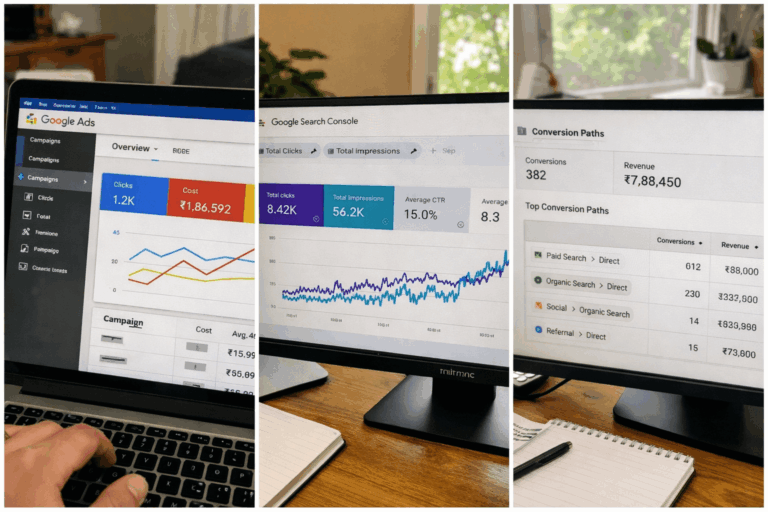
Conclusion:
SEO and Google Ads are not enemies — they are tools. The real question is not “Which is better?” but “Which is right for my business stage, margins, and cash flow right now?”
- SEO wins when you want long-term stability, lower blended acquisition costs, and brand authority that compounds over time.
- Google Ads wins when you need immediate lead flow, fast market validation, or short-term revenue control.
- Both make sense when your tracking is solid, CAC is proven below LTV, and you are scaling strategically — not emotionally.
- Neither makes sense if you don’t track revenue properly, don’t understand your margins, or are spreading your budget too thin.
In 2026, rising CPCs, AI-driven automation, and SEO volatility mean one thing: undisciplined marketing is expensive marketing.
The businesses that win are not the ones spending the most — they are the ones measuring the best.
SEO vs Google Ads For Local Businesses: FAQs
You should only consider shifting fully to Ads if you urgently need immediate cash flow and SEO isn’t yet generating meaningful leads. However, stopping SEO completely can hurt long-term stability, so it’s better to reassess and optimize rather than abandon it impulsively.
Three months is usually too early to judge SEO performance. Most local businesses start seeing consistent movement between 6–9 months, especially in competitive markets. Focus on upward trends in impressions, rankings, and qualified traffic rather than expecting instant lead volume.
In many competitive industries, CPCs have increased significantly, making Ads expensive without proper tracking. If you don’t know your exact cost per closed deal and profit margins, rising ad costs can quietly damage profitability.
In most cases, no. SEO builds long-term organic stability, but Ads still play a key role in testing new services, running seasonal campaigns, and retargeting visitors. A balanced approach often reduces risk and improves control.
Don’t rely on clicks, impressions, or lead counts alone — track real revenue and cost per sale. If a channel cannot clearly show ROI and contribution to closed deals, you’re making decisions based on incomplete data.
References
About the Author