
Table of Contents
ToggleHow Long Does SEO Take For Small Businesses In India?
“It’s been 3 months. Why am I not ranking?”
A physiotherapy clinic owner in Ahmedabad once told me this after paying ₹45,000 per month to an agency. The agency had promised “Page 1 in 90 days.” He was tracking keyword positions every week. Traffic had increased slightly. Revenue hadn’t.
He thought SEO wasn’t working. The agency said, “Sir, impressions are growing.”
He said, “But patients aren’t.”
That gap — between traffic and business impact — is where most Indian small businesses lose money.
In my experience auditing SEO campaigns for small Indian businesses:
- 70% start with unrealistic timelines.
- 60% don’t understand what determines ranking speed.
- 40% shouldn’t have started SEO in the first place.
Most blogs say: “SEO takes 3–6 months.”
That’s not advice. That’s hope packaged as certainty. The real answer?
SEO timelines depend on business fundamentals, competition strength, execution quality, and patience — not a calendar. Let’s break this down honestly. [How Long Does SEO Take For Small Businesses In India?]

Ground Reality: Why SEO Timelines in India Are Getting Longer
Five years ago, ranking in Tier-2 cities was easier. Today:
- Every clinic, coaching class, CA firm, and D2C brand is “doing SEO.”
- CPCs in Google Ads have increased.
- Content quality expectations are higher.
- Google’s algorithm updates are stricter.
SEO is more competitive now. And here’s where Indian businesses go wrong:
Unrealistic 3-Month Expectations
In metro cities like Ahmedabad, Mumbai, Bangalore — if you’re competing in:
- Healthcare
- Education
- Real estate
- Finance
Three months is barely enough to fix technical issues and publish foundational content.
Confusing Traffic with Business Growth
10,000 visitors mean nothing if:
- Your offer is weak
- Your sales process is broken
- Your pricing is unrealistic
- Your reviews are poor
SEO amplifies what exists. It doesn’t fix weak businesses.
Cheap SEO Packages (₹10k–₹15k/month)
Let me be blunt. ₹15,000/month usually buys:
- 2–4 low-quality blogs
- Spam backlinks
- Generic keyword reports
No real strategy
₹50,000/month (properly used) can buy:
- Technical cleanup
- Competitive research
- Strong content
- Real link building
- Tracking setup
- CRO improvements
Most small businesses compare price, not depth of work. That’s expensive in the long run. [How Long Does SEO Take For Small Businesses In India?]

Step-by-Step Breakdown: What Actually Decides Your SEO Timeline
Step 1: Market & Competition Reality Check
What to do:
Search your primary keywords. Who ranks?
- Funded startups?
- Aggregators?
- 10-year-old businesses?
- Or small local competitors?
Why it affects timeline:
If you’re competing with funded players investing ₹3–10 lakhs/month in content and backlinks — your 6-month expectations are unrealistic.
Mistake to avoid:
Thinking “They are ranking, so we can too.”
Pro tip:
If top 5 results have:
- 100+ referring domains
- Years of content
- Strong brand searches
Expect 9–18 months minimum.
Step 2: Website & Technical Health Audit
Most SEO delays happen here. Common issues I see:
Slow Mobile Load Times
If your website takes more than 3–4 seconds to load on mobile, users leave before even seeing your offer. In India, most traffic is mobile-first. Slow speed kills conversions, increases bounce rate, and delays SEO progress because Google prioritizes mobile performance. Many small businesses lose revenue here before SEO even begins.
No Internal Linking Structure
Without internal linking, your pages don’t “talk” to each other. Google struggles to understand which pages matter most, and authority doesn’t flow properly across the site. This slows down ranking growth significantly. It’s one of the most ignored structural issues in small business websites.
Duplicate Content
When multiple pages have similar or copied content, Google gets confused about which one to rank. This weakens your overall authority and can suppress visibility. Many small businesses unknowingly duplicate service pages across locations, delaying SEO impact by months.
No Schema Markup
Schema helps search engines understand your business type, services, reviews, and location clearly. Without it, you miss out on enhanced search features like rich snippets and local visibility boosts. It doesn’t create instant rankings, but it improves trust and click-through rates over time.
No Conversion Tracking
If you’re not tracking calls, form submissions, or WhatsApp clicks, you cannot measure SEO ROI. Many businesses think SEO isn’t working when in reality, leads are coming but not being tracked properly. Without data, you’re guessing — and guessing is expensive.
Broken Pages
Broken links and 404 pages create poor user experience and waste Google’s crawl budget. Over time, this reduces site credibility and slows ranking progress. It also makes your business look unprofessional, especially when paid traffic lands on non-working pages. [How Long Does SEO Take For Small Businesses In India?]
Step 3: Content & Authority Gap
Ask this honestly: “Do we deserve to rank?”
If your competitor has:
- 60 well-written blogs
- Location pages
- FAQs
- Case studies
- Reviews
- Backlinks
And you have:
- 5 generic blogs
Step 4: Budget & Timeline Alignment
If you have:
- 3-month cash runway
- Survival pressure
- Staff salaries at risk
SEO is the wrong first move. You need revenue now. No visibility later.
In such cases:
- Run ads
- Improve conversion rate
- Fix sales
- Improve offer
Then build SEO.
Step 5: Local SEO vs National SEO
| Type | Realistic Timeline |
|---|---|
| Local (Low Competition) | 4–8 months |
| Local (Metro Healthcare/Education) | 6–12 months |
| National | 9–18+ months |
If someone promises national ranking in 6 months in India today — question their honesty.
Step 6: ROI Forecasting
From audits across 50+ small businesses:
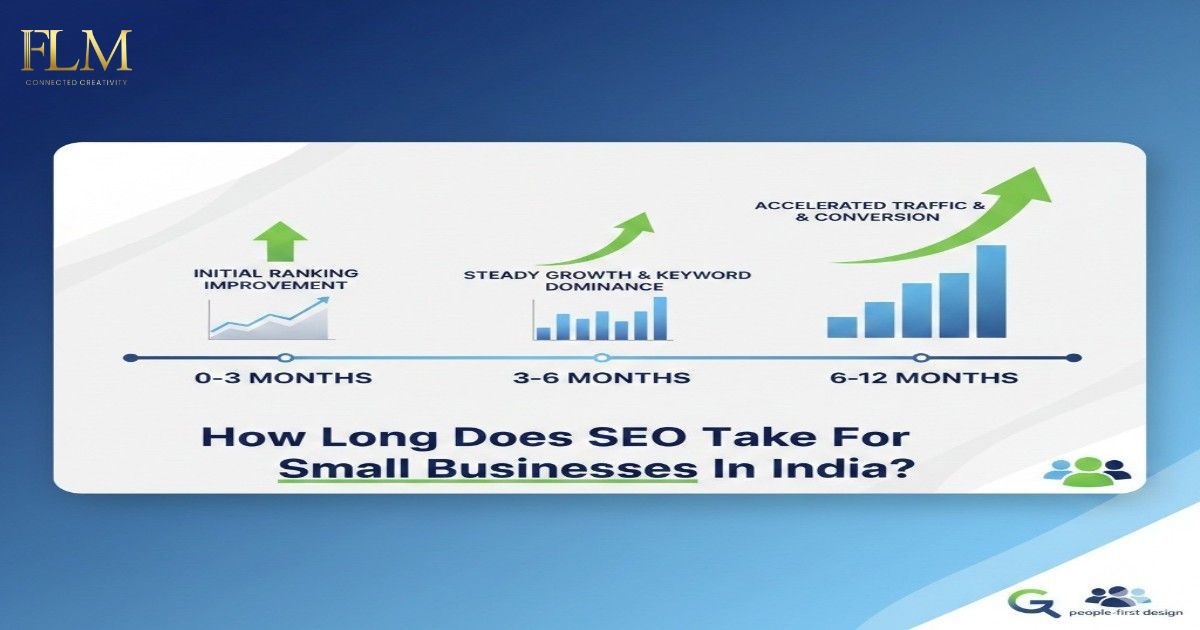
Months 1–3: Setup, Fixes, Foundation
This phase is not about rankings — it’s about fixing what’s broken. Technical issues, tracking setup, content gaps, internal linking, and site structure are cleaned up here. Most businesses underestimate how much groundwork is required before Google even trusts the site. If you expect revenue in this phase, you’ll feel disappointed.
Months 4–6: Early Ranking Movement
This is when you start seeing keyword movement — not necessarily top rankings, but progress. Long-tail keywords may enter Page 1, and impressions begin to increase. Traffic is still modest, but Google is testing your content. If strategy is correct, this phase builds confidence — not profits yet.
Months 6–9: Traffic Increase
Organic traffic becomes more noticeable during this stage. Multiple keywords rank, and you may start getting consistent leads — especially in local SEO. However, conversion rate now becomes critical. Poor landing pages or weak offers can waste this growth phase.
Months 8–12: Revenue Impact (If Conversion Is Strong)
Organic traffic becomes more noticeable during this stage. Multiple keywords rank, and you may start getting consistent leads — especially in local SEO. However, conversion rate now becomes critical. Poor landing pages or weak offers can waste this growth phase. [How Long Does SEO Take For Small Businesses In India?]
When NOT to Start SEO
Do NOT start SEO if:
You Don’t Have Tracking in Google Analytics and Google Search Console
If tracking isn’t properly set up, you’re operating blind. You won’t know which keywords drive traffic, which pages convert, or whether SEO is improving over time. Many small businesses stop SEO early simply because they can’t see progress clearly. Without data, every decision becomes guesswork — and guesswork wastes money.
You Don’t Know Your CAC (Customer Acquisition Cost)
If you don’t know how much it costs to acquire a customer, you cannot judge whether SEO is profitable. SEO may bring leads, but if your sales conversion is weak or margins are low, it won’t feel successful. Understanding CAC helps you decide whether SEO should be a long-term investment or not.
Your Offer Isn’t Validated
SEO can bring traffic — but it cannot make a weak offer attractive. If customers aren’t buying from paid ads, referrals, or offline efforts, organic traffic won’t magically convert either. Fix product-market fit first. Otherwise, you’ll blame SEO for a business problem.
You Are in Survival Mode
If your business needs immediate cash flow to survive the next 2–3 months, SEO is not your priority. SEO takes time to compound. In survival mode, focus on direct revenue channels like ads, referrals, partnerships, or sales outreach. Working with a digital marketing agency helping local businesses can also help you identify faster short-term growth opportunities while building a long-term strategy. Start SEO only when your runway is stable.
You Expacted Guaranteed Ranking
Anyone promising guaranteed rankings in a specific timeline is either inexperienced or dishonest. Google’s algorithm is unpredictable and competitive landscapes change constantly. Expecting guarantees leads to frustration and poor decisions. SEO is strategic investment — not a fixed-return scheme. [How Long Does SEO Take For Small Businesses In India?]

Real Case Studies
Case 1: Physiotherapy Clinic – Ahmedabad
Industry: Healthcare
Budget: ₹35,000/month
Starting condition:
- 1-page website
- No structured content
- Weak Google Business Profile
- No backlinks
Months 1–3
- Technical fixes
- Location pages
- Service pages
- GMB optimization
Months 4–6:
- Rankings improved for long-tail keywords
- Traffic increased from 120 to 650/month
What worked:
- Local SEO focus
- Reviews strategy
- Consistent content
What failed:
Early focus on competitive “best physiotherapy clinic” keyword
Lesson: Local SEO works — but not in 90 days.
Case 2: EdTech Startup – National Targeting
Industry: Online education
Budget: ₹1.2 lakh/month
Competition: High (funded players ranking)
Months 1–6:
- Massive content production
- Authority building
- Very slow ranking movement
Month 6
Traffic: Moderate
Revenue impact: Minimal
Month 12:
- Significant ranking for mid-intent keywords
- CAC via SEO became 40% lower than paid ads
Course correction:
- Stopped targeting broad keywords
- Focused on bottom-funnel topics
Lesson: In competitive industries, 12 months is realistic — not 6.

Real Testimonials
“After 4 months I thought SEO was a waste. Month 8 changed everything.”
— Dr. Mehul Patel, Clinic Owner, Gujarat
“We almost paused SEO at month 5. Good thing we didn’t.”
— Rohit Sharma, Coaching Institute Founder
“We were tracking rankings, not revenue. That was our mistake.”
— Neha Agarwal, Marketing Head, D2C Brand

Data & Market Context
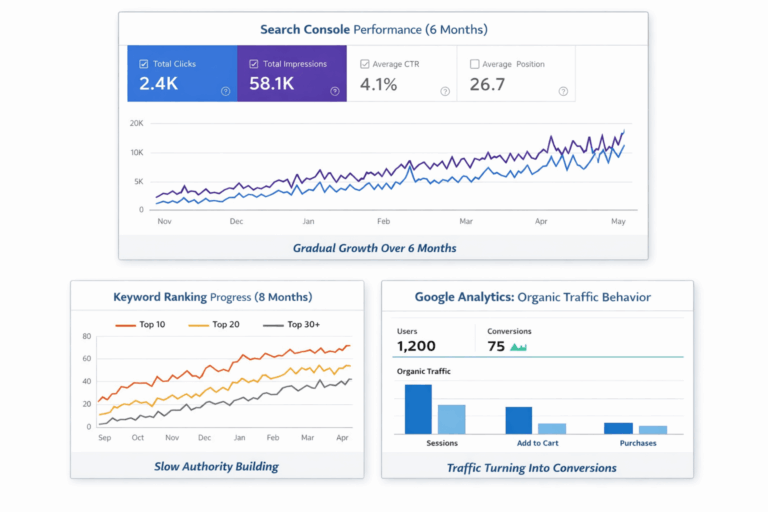
From repeated audits of:
- Google Search Console
- Google Analytics
Patterns observed:
- Impressions grow before clicks.
- Rankings fluctuate heavily in the first 4–6 months.
- Organic traffic converts better after brand familiarity increases.
Google Ads CPC in Indian healthcare and education has increased significantly in the last 3–4 years. SEO competition has intensified. Also, algorithm updates (core updates) have reduced the impact of spam backlinks. SEO timelines today are longer than 5 years ago.
Proof & Screenshot
Conclusion:
SEO is not slow. Weak strategy is slow. Unrealistic expectations are expensive.
In India today:
- Local SEO: 6–9 months realistic.
- Competitive SEO: 9–18 months realistic.
- Revenue impact: Usually after foundation is built.
Before signing your next SEO contract, ask:
- Do we deserve to rank?
- Do we have patience?
- Do we have a budget?
- Are we tracking revenue, not rankings?
If not — pause. Clarity saves more money than optimism.
How Long Does SEO Take For Small Businesses In India?: FAQS
Three months is usually enough to fix technical issues and start seeing ranking movement — not revenue impact. Real traffic growth typically begins after 4–6 months if execution is strong. Expecting business results in 90 days is unrealistic in most industries today.
Common reasons include strong competition, weak content quality, poor backlinks, or technical issues. Sometimes rankings are improving slowly but expectations are too aggressive. SEO delays are usually strategy or execution problems — not “Google ignoring you.”
Yes, local SEO in low-competition cities can show results in 4–8 months. National SEO usually takes 9–18+ months because you compete against established brands and funded players. The broader the target, the longer the timeline.
In most cases, yes. Ads provide immediate traffic and valuable keyword data, while SEO builds long-term organic visibility. Combining both reduces financial pressure during the SEO waiting period.
Look at keyword movement, impressions growth in Search Console, and increasing organic traffic — not just Page 1 rankings. Early growth is gradual and uneven. If nothing changes in 4–6 months, the strategy likely needs correction.
REFERENCES
About the Author