
Many agencies sell backlink packages, but backlinks alone rarely solve ranking problems. If the website lacks authority, service pages are weak, or local relevance is missing, links won’t make much difference. Businesses often end up paying for links that never move rankings, especially when they don’t understand how service business websites rank on Google and what actually influences visibility in search results.
Table of Contents
ToggleHow To Rank A Service Business Website On Google?
How To Rank A Service Business Website On Google?: A plumbing company owner once showed me three SEO reports from three different agencies. All three reports said the same thing:
- “Traffic is increasing”
- “Keywords are ranking”
- “Backlinks are growing”
But the owner asked me one simple question:
“If SEO is working… why am I still getting most of my customers from referrals?”
After reviewing the campaign, the reality was obvious.
The website was ranking for informational blog keywords, not for actual plumbing service searches. Traffic looked great in reports. But the traffic had zero buying intent.
In other words: The SEO campaign was optimized for reports, not revenue.
However, this is the truth: clients in Ahmedabad are not just depending on the word of the mouth and the conventional advertising such as newspapers and billboards.
They are instead searching online, reviewing, and comparing before purchasing a product or service or booking a service.
Why Most SEO Advice Fails Service Businesses
In my experience auditing SEO campaigns for service businesses, most online SEO advice focuses on things that do not actually decide rankings for local service companies.
Most blogs talk about:
- algorithms
- backlinks
- keyword density
- SEO tools
But they ignore the real business questions:
- Are people actually searching for your service?
- Is your website convincing enough to generate inquiries?
- Are you targeting realistic search terms?
- Are you visible in local search results, where most service leads come from?
Ranking a service business website on Google is not primarily a technical SEO problem.
It is a market positioning, trust, and visibility problem.
Understanding this difference can save businesses thousands of dollars in wasted SEO spending.
The Real Problems Service Businesses Face With SEO
After auditing dozens of service business SEO campaigns, certain patterns appear again and again.
1. Backlinks Are Purchased Without Strategy
2. Traffic Grows But Leads Do Not
This happens when websites rank for:
- informational keywords
- blog topics unrelated to services
- national keywords for a local business
Example:
A cleaning company ranking for: “how to remove carpet stains”
This traffic does not convert into bookings.
3. Businesses Target Impossible Keywords
Many service businesses try to rank for extremely competitive keywords like:
- “digital marketing agency”
- “real estate company”
- “interior designer”
Without local targeting. These keywords are dominated by large brands and directories. The result:
Months of SEO work with no ranking movement.
4. Websites Are Not Designed To Convert Leads
Even if a page ranks, it may fail to generate inquiries because:
- the offer is unclear
- there are no trust signals
- contact options are hidden
- service pages lack detail
Google can send traffic, but the website must convert it.
5. Confusion Between SEO and Google Ads
Many businesses assume: SEO = faster results.
But in reality:
- Google Ads produces leads faster
- SEO builds long-term visibility
Using the wrong channel at the wrong time wastes the budget.
6. AI Content Flooding Websites
Recently I’ve seen service websites publish:
- 50–100 AI-generated blog posts
- thin pages targeting every keyword
The assumption is:“More content = more rankings.”
In reality:
- Google now rewards topical authority and trust, not bulk content.
- Many of these websites see ranking drops after algorithm updates.

The Real Decision Framework For Ranking On Google
Step 1: Business & Market Clarity
What To Do
Understand:
- which services have real demand
- where customers search from
- what search terms they use
Example:
Instead of targeting:
“home renovation”
Target:
“home renovation contractor in Gandhinagar”
Why It Matters
- Google rankings depend heavily on search intent alignment.
- If the keyword does not match the service offer, rankings may occur but leads will not.
Mistakes To Avoid
- targeting national keywords for local services
- guessing keywords without research
- ignoring local search intent
Pro Tip From Experience
Before starting SEO, check search demand using:
- Google search suggestions
- Google Search Console
- SEO keyword tools
If demand is weak, SEO will struggle regardless of effort.
Step 2: Website & Offer Readiness
What To Do
Evaluate whether the website is ready to convert visitors. Key factors:
- clear service pages
- strong trust signals
- testimonials
- contact accessibility
- professional design
Why It Matters
- Google increasingly measures user experience and engagement signals.
- If users quickly leave your website, rankings often decline over time.
Mistakes To Avoid
Launching SEO with:
- a template website
- generic service pages
- no location relevance
Pro Tip From Experience
One strong service page often ranks better than 20 weak pages.
Step 3: Keyword & Search Intent Strategy
What To Do
Focus on:
- commercial intent keywords
- service + location combinations
- problem-solution searches
Examples:
- “AC repair in Ahmedabad”
- “emergency plumber near me”
Why It Matters
- These searches show immediate buying intent.
- Ranking here generates actual leads, not just traffic.
Mistakes To Avoid
- writing blogs unrelated to services
- chasing high search volume keywords
- ignoring local modifiers
Step 4: Local SEO & Authority Signals
What To Do
For most service businesses, local search results drive the majority of leads. This includes:
- Google Business Profile
- map listings
- local citations
- reviews
Why It Matters
Optimize:
- Google Business Profile
- NAP consistency (Name, Address, Phone)
- customer reviews
- local directory listings
Mistakes To Avoid
- Many service searches trigger the local map pack, which appears above organic results.
- Ranking here often generates more leads than traditional SEO.
Pro Tip From Experience
Businesses with consistent reviews and location relevance often outrank websites with stronger SEO.
Step 5: Content & Topical Authority
Content should focus on:
- service explanations
- buyer concerns
- pricing factors
- service comparisons
What Works Best
- detailed service pages
- location pages
- buyer guides
What Usually Fails
Mass blog publishing with no topical strategy.
Pro Tip From Experience
Instead of writing: 20 random blogs
Create: 5 highly detailed service guides linked to core service pages.
Step 6: Backlinks & Authority Building
Backlinks still matter. But not the way many agencies sell them.
What Works Best
- local business mentions
- industry directories
- partnerships
- media mentions
What Often Fails
- mass backlink packages
- private blog networks
- low-quality guest posts
A few relevant local backlinks often outperform hundreds of generic ones.
Step 7: Tracking, Analytics & Lead Attribution
Many businesses measure the wrong metrics. They focus on:
- keyword rankings
- impressions
- traffic
Instead of actual leads.
What To Track
- form submissions
- phone calls
- booked consultations
- lead sources

Real Case Studies
Case Study 1 — Local Home Services Company
Industry: Home Cleaning
Location: Ahmedabad
Monthly Marketing Budget: ₹80,000
Initial Problems
- SEO agency building backlinks
- blog traffic growing
- almost zero inquiries
Strategy Shift
We focused on:
- local service pages
- Google Business Profile optimization
- review generation
- location keywords
Results After 9 Months
- organic leads increased 4x
- map pack visibility improved
- cost per lead decreased
Lesson
Local relevance often matters more than backlinks.
Case Study 2 — Scaling A Real Estate Service Brand
Industry: Real Estate Consulting
Budget: ₹2–3 lakh per month
Initial Problems
- high-quality location pages
- buyer guides
- local authority backlinks
Challenges
- strong competition from property portals
- slow ranking growth
Course Correction
Focused on:
- long-tail buyer searches
- detailed local market content
Outcome
Within 12 months:
- multiple first-page rankings
- consistent organic inquiries
Lesson
SEO growth is gradual but cumulative.

What Real Clients Usually Say
“Our previous SEO agency kept sending reports about traffic. After fixing our service pages and local SEO, we finally started getting real inquiries.”
- Founder – Home Services Company
“The biggest change was focusing on buyer intent instead of keyword volume. That shift improved lead quality dramatically.”
- Marketing Head – Property Advisory Firm
“We stopped publishing random blog posts and focused on authority content. That made a bigger difference than months of backlink building.”
- Director – Renovation Business

Market Data & Tools Used For Analysis
SEO performance is typically evaluated using:
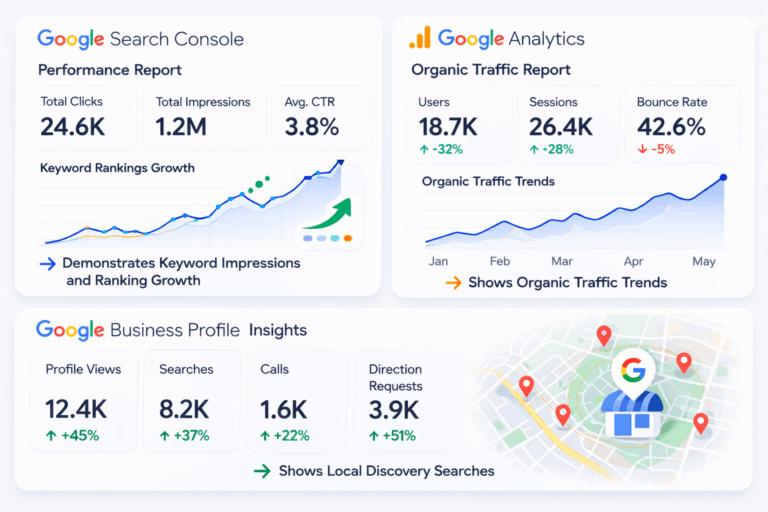
Google Analytics
Google Analytics helps you understand how visitors interact with your website. It shows where your traffic comes from, which pages users visit, how long they stay, and what actions they take. You can track conversions, user behavior, and overall website performance. This data helps businesses identify what is working and where improvements are needed to grow traffic and leads.
Google Search Console
Google Search Console provides insights into how your website performs in Google search results. It shows which keywords bring users to your site, along with impressions, clicks, and average rankings. The tool also helps identify indexing issues, crawl errors, and mobile usability problems. It is essential for monitoring and improving your website’s SEO performance.
Google Business Profile Insights
Google Business Profile Insights shows how customers discover and interact with your business listing on Google Search and Maps. It provides data such as profile views, calls, direction requests, and website visits. Businesses can also see how customers search for their services. These insights help you understand local visibility and improve your local marketing strategy.
SEO Benchmarking Tools
SEO benchmarking tools like Ahrefs, SEMrush, and Moz Pro help analyze your website’s SEO performance compared to competitors. They track keyword rankings, backlinks, domain authority, and search visibility. These tools help identify opportunities for improvement and uncover gaps in your SEO strategy. Businesses use them to measure progress and stay competitive in search results.

Who This Guide Is NOT For
This guide is not for businesses that:
- expect overnight rankings
- want SEO hacks
- want guaranteed positions on Google
- have no patience for 6–12 month strategies
- have no marketing budget
SEO requires consistent execution and patience. If you want instant leads, Google Ads is usually better.
Proof & Screenshot
Conclusion:
Ranking a service business website on Google is not about:
- algorithms
- backlins
- SEO tricks
It is about:
- trust
- relevance
- authority
- real search demand
Businesses that understand this usually make smarter marketing decisions.
How To Rank A Service Business Website On Google?: FAQS
01
SEO usually takes 6–12 months to show strong results for most service businesses. The timeline depends on competition, website quality, and demand in your local market.
02
If you need leads quickly, Google Ads can generate results almost immediately. SEO works better for building consistent, long-term organic leads.
03
Instead of competing broadly, focus on niche services, specific locations, and deeper content. Targeted strategies often work better than trying to outrank large websites directly.
04
Ask for real data like Search Console reports, lead tracking, and keyword ranking improvements. Avoid agencies that only show traffic graphs without business results.
05
AI can help draft content, but it rarely builds strong authority on its own. Search engines reward expertise, trust, and real experience in service-based content.
References
About the Author

Mitesh Vyas
Hi, I’m Mitesh Vyas, an SEO Specialist with 7+ years of hands-on experience in helping businesses grow through organic search. I focus on creating SEO strategies that not only rank but also drive real business growth.
I specialize in Technical SEO, On-Page Optimization, High-Quality Link Building, and Local SEO strategies that drive measurable rankings and revenue.
I have worked with startups, local businesses, and agencies to improve search visibility, increase website traffic, and generate qualified leads using Google-compliant, white-hat SEO practices.


