
Table of Contents
ToggleDigital Marketing Cost For Small Businesses In India 2026
Digital Marketing Cost For Small Businesses In India: Last quarter, I audited the digital spend of a 2-outlet cloud kitchen in Pune. The founder was spending ₹65,000/month on ads, SEO, “reels management,” and three tools he barely used. Revenue was flat. The leads were noisy. The agency’s advice? “Increase budget. The algorithm needs learning.”
That sentence alone has drained more small-business bank accounts than bad products ever did.
In my experience auditing digital marketing budgets for small Indian businesses, most articles about “digital marketing cost” are written to sell hope, not protect cash. They list price ranges like a menu—₹15k for SEO, ₹30k for ads—without telling you when spending anything at all is a mistake. This guide is the opposite: clarity over comfort. No sales talk. No “just invest more” nonsense.

Real Business Problems
Here’s what decision-makers actually struggle with in 2026:
No clear answer on “how much is enough”
There is no universal “right budget” in digital marketing — only a budget that matches your margins, patience, and ability to absorb learning losses. I’ve seen ₹20k/month outperform ₹2 lakh/month because focus beats fragmentation. When money is split across five channels, nothing gets enough signal to improve. “Enough” is what lets one channel run long enough to prove or disprove itself.
Paying retainers with no measurable ROI
Fixed monthly fees feel safe until results dip and the bill doesn’t. Many businesses keep paying because stopping feels like admitting failure. Effort is easy to justify; revenue impact is harder. If fees don’t move when outcomes collapse, you’re paying for activity, not value. That’s how slow budget leaks happen.
Agencies inflating effort, not outcomes
Weekly reports full of screenshots look busy but don’t answer the only question that matters: did this make money? More campaigns, more creatives, more “tests” often hide the absence of learning. When effort becomes the deliverable, outcomes become optional. That’s a dangerous incentive for any cash-strapped business.
Confusion between SEO vs Ads vs Social vs Influencer spend
Running four channels at once feels like diversification, but for small budgets it’s dilution. Each channel needs time, data, and iteration to work. When everything runs together, nothing runs long enough to teach you what actually converts. You end up funding experiments without conclusions — and repeating the same mistakes next quarter.
Tool subscriptions & AI tools draining budgets
Tools promise leverage, but most small teams don’t use 70% of what they pay for. CRM, automation, heatmaps, AI writers — each sounds “small” until they add up. If a tool doesn’t change a decision you make or a cost you cut, it’s dead weight. Tools don’t fix strategy; they only amplify it when it’s already clear.
Rising platform costs without proportional returns
Auction-driven platforms mean your costs rise when competitors panic-bid, even if your execution improves. I’ve watched CPC climb on Google Ads and Meta Ads while lead quality quietly fell. Platforms optimize for their revenue, not your profitability. If your unit economics are thin, rising CPCs will expose that fast.
Common budget mistakes I’ve personally seen
- Local services blowing money on national keywords
- D2C brands paying influencers before unit economics made sense
- B2B founders buying SEO packages without sales follow-up
- Franchise owners running duplicate ads across locations competing with themselves
On-ground patterns
- Local services: Over-spend on awareness; under-invest in call tracking & follow-ups
- D2C brands: CAC ignored until cash flow breaks
- B2B SMBs: Long sales cycles + ad impatience = premature shutdown
- Franchises: Central spends don’t translate to local footfall

Step-by-Step Decision Framework
Step 1: Business Stage & Revenue Clarity
What to do:
Write down your monthly gross margin and how much you can lose for 3 months without hurting payroll. Before you touch any marketing budget, get brutally clear on two numbers: your monthly gross margin and how much cash you can afford to lose for three straight months without risking salaries or operations. Marketing experiments don’t pay back immediately, and pretending they will is how founders end up funding ads from personal savings. This exercise forces you to respect your cash runway. If the answer makes you uncomfortable, that’s your signal to pause spending and fix the business math first.
Why it matters:
Marketing is not rent. If you can’t afford learning losses, don’t buy learning.
Mistakes to avoid:
Funding ads from personal savings.
Pro tip:
If your gross margin is under 25%, pause paid ads. Fix margins first.
Step 2: Channel Cost Mapping (SEO vs Ads vs Social vs Local Listings)
What to do:
Don’t look at channel costs in isolation — add up everything it actually takes to run that channel properly: agency or freelancer fees, tools, content creation, and your own management time. What looks like “₹15k for SEO” often becomes ₹40k once content, fixes, and reporting are included. Underestimating real costs leads to half-baked execution and wrong conclusions about what “doesn’t work.” If you can’t afford the full cost of one channel, you can’t afford to test that channel at all.
Why it matters:
Cheap-looking SEO often costs more when you add content, dev fixes, and time.
Mistakes to avoid:
Running SEO, ads, and influencers together with ₹30k total.
Pro tip:
Pick one revenue channel, one supporting channel. Kill the rest for 90 days.
Step 3: Budget Allocation & ROI Reality Check
What to do:
Set a test budget you can lose without checking dashboards every hour or second-guessing every decision. If the money is emotionally painful to spend, you’ll kill campaigns too early or keep tweaking blindly. Marketing tests need room to fail before they work. A calm budget leads to calm decisions — and calm decisions are how you actually learn what converts.
Why it matters:
Panic ruins optimization.
Mistakes to avoid:
Doubling spend because “results will come next month.”
Pro tip:
Set a stop-loss. If CPL rises 30% with no sales quality lift, pause.
Step 4: Agency / Freelancer Cost vs Value Evaluation
What to do:
Structure fees around outcomes you can actually verify, like qualified leads or booked calls — not impressions, reach, or “engagement.” You can’t pay salaries with dashboards, but you can with revenue. When fees are tied to business impact, priorities change fast. If an agency resists outcome-linked accountability, that’s your signal they’re selling effort, not results.
Why it matters:
Effort doesn’t pay your bills.
Mistakes to avoid:
Long retainers without exit clauses.
Pro tip:
Ask for one business metric they’ll be accountable for.
Step 5: Tracking Actual Cost Per Lead / Sale
What to do:
Track what drains or grows your cash: cost per lead and cost per sale. Click-through rate and reach feel good, but they don’t pay bills. High CTR with low-quality leads is just expensive noise. When you anchor decisions to CPL and cost per sale, bad channels expose themselves quickly — and good ones finally get the budget they deserve.
Why it matters:
Vanity KPIs hide cash burn.
Mistakes to avoid:
Celebrating traffic growth with no inquiries.
Pro tip:
Use Google Analytics and Google Search Console to connect traffic to outcomes.
Step 6: Scale vs Pause Decisions
What to do:
One good month is noise; two profitable months in a row is a pattern you can trust. Scaling on a single spike usually means you’re amplifying luck, seasonality, or a temporary discount effect. When you wait for repeatable profitability, you protect cash and avoid emotional scaling. Growth that isn’t repeatable is just expensive excitement.
Why it matters:
One good month is lucky. Two is a pattern.
Mistakes to avoid:
Scaling during seasonal spikes.
Pro tip:
Pause when margins shrink—even if leads grow.

Real Case Studies
Case 1: Local Service – Dental Clinic (Tier-2 City)
- Budget: ₹40,000/month
- Channels: Search ads + local listings
- Result (9 months): CPL dropped from ₹1,200 to ₹650; appointment show-up rate rose after call tracking
- What worked: Tight keyword focus, pausing display ads
- What failed: Instagram awareness ads
- Lesson: Local intent beats broad visibility
Case 2: Scaling D2C Brand – Home Decor
- Entry strategy: Performance ads + micro-influencers
- Budget growth mistake: Jumped from ₹1.2L to ₹3L/month without margin buffer
- Course correction: Cut influencers, fixed landing pages
- Final outcome: CAC stabilised at 22% of AOV
- Lesson: Scale only after unit economics are proven

Social Proof
“Spent ₹50k/month for 4 months. Leads came, conversions didn’t. Paused ads, fixed sales calls. Ads work now, but they weren’t the problem.”
-Amit Verma, Founder – Local Gym (Noida)
“Our agency’s reports looked great. Revenue didn’t. We cut channels to one. The pipeline finally became predictable.”
-Neha Kulkarni, Marketing Head – B2B SaaS (Pune)
“Digital helped footfall, not profits. We still had to fix in-store experience. No dashboard fixes that.”
-Rakesh Iyer, Operator – Franchise Outlet (Bengaluru)

Verified Data & Market Context
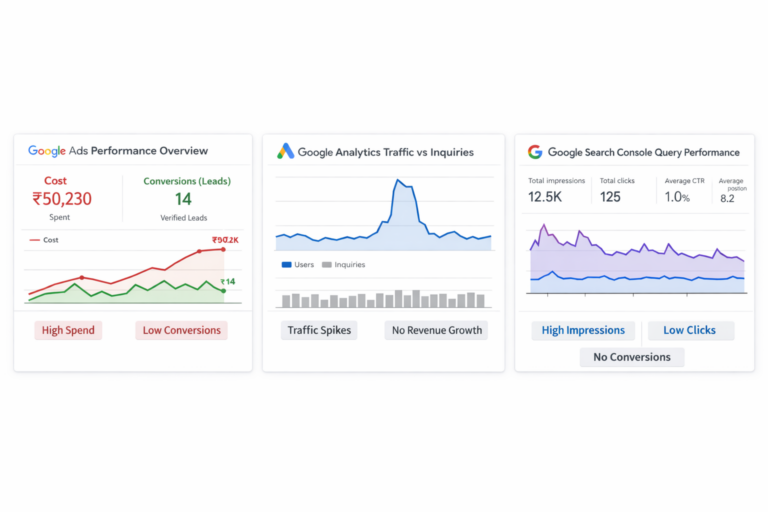
Ad dashboards from Google Ads and Meta Ads
Ad dashboards show what you’re paying for every click, impression, and conversion — not what you’re earning. This is where rising CPCs and dropping conversion quality first become visible. If you’re not reviewing these weekly, you’re flying blind on cash burn. Dashboards don’t lie, but they also don’t explain why results changed — that’s your job.
Traffic-to-lead mapping in Google Analytics
Traffic numbers mean nothing until they’re mapped to actual inquiries, calls, or purchases. Analytics helps you see which pages and sources bring leads, not just visitors. This is where most “growth” stories fall apart — traffic rises, leads don’t. If traffic isn’t tied to revenue events, it’s a vanity metric.
Query intent in Google Search Console
Search Console reveals what people actually type before landing on your site — and whether that intent matches your offer. High impressions with low clicks usually mean you’re visible for the wrong queries. Ranking for irrelevant terms feels like progress but brings zero business value. This data helps you kill SEO efforts that look good but don’t convert.
Reality check:
Digital marketing cost in India is platform-driven, auction-based, industry-cycle dependent, and heavily influenced by competition density. 2024–2026 saw CPC inflation in crowded niches and stricter attribution policies. Your costs go up even when your execution improves, which is why businesses increasingly look for affordable digital marketing services that balance performance efficiency with sustainable budget control.

Who This Guide Is NOT For
Not for:
- ₹5,000/month miracle chasers
- Founders expecting results in 30 days
- Businesses unwilling to track ROI
- Anyone outsourcing thinking
This won’t help with:
- Overnight results
- Viral hacks
- Guaranteed CPL
- Gaming platforms
Proofs & Screenshot
Conclusion:
Digital Marketing Cost For Small Businesses In India 2026: Digital marketing cost isn’t a price list—it’s a risk decision. Spend when your business can absorb learning losses. Pause when the math doesn’t work. Ignore anyone who treats higher budget as a strategy.
If you want, grab a free self-audit checklist or a simple budget planning worksheet.
Or drop your industry + budget range and I’ll tell you what NOT to do first.
Digital Marketing Cost For Small Businesses In India : FAQs
Enough to run one channel properly for 90 days. For most SMBs, ₹25k–₹60k/month focused, not scattered.
Ads if you need immediate demand capture. SEO if you can survive 6–9 months without ROI. Don’t do both half-heartedly.
If fees don’t change when results crash, it’s not fair. Outcome risk should be shared.
Auction pressure + competition density + weaker landing pages. Platforms don’t owe you efficiency.
Yes. Thin margins + paid acquisition = slow bleed.


