
Table of Contents
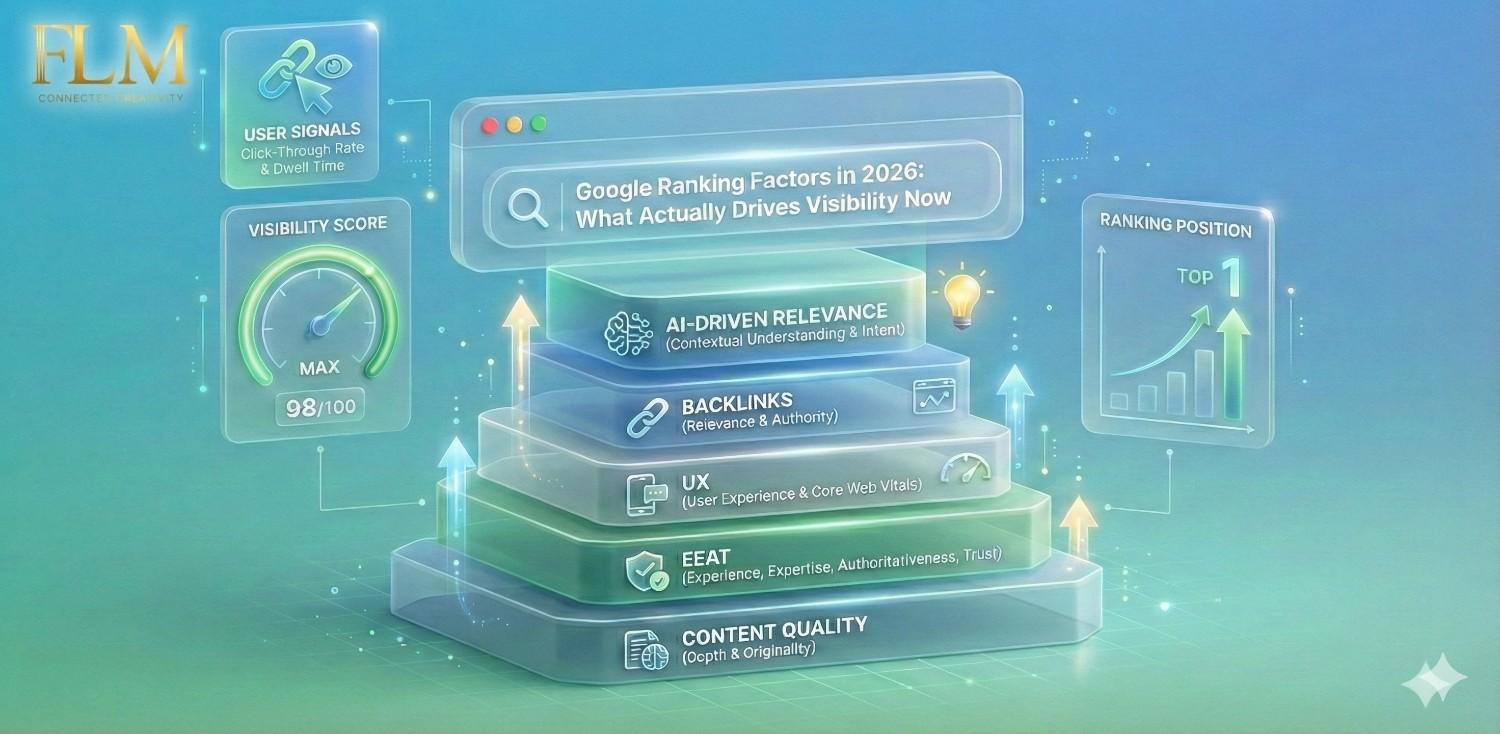
ToggleGoogle Ranking Factors in 2026: What Actually Drives Visibility Now
Google rankings in 2026 no longer reward websites that “look good on paper.” Over the last few years, I’ve worked closely with real estate developers, brokers, and local service businesses who followed every traditional SEO checklist—yet still lost visibility. The reason was simple: Google stopped rewarding tactics and started rewarding outcomes.
Today, rankings depend on whether your content genuinely helps a real person make a decision, whether your brand feels trustworthy beyond your website, and whether Google’s AI systems can clearly understand who you are, what you specialise in, and why you should be trusted.
With Search Generative Experience (SGE), AI-driven ranking systems, and tighter quality evaluation, SEO in 2026 is less about optimisation tricks and more about clarity, credibility, and usefulness. This guide breaks down what actually moves rankings today—based on real campaigns, failed strategies, and what’s working right now.

1. Content Experience Is the New Ranking Foundation
In 2026, Google doesn’t reward content volume. It rewards content outcomes.
From my experience in real estate SEO, the biggest ranking improvements came not from publishing more blogs, but from fixing content that left users confused or unsure about their next step.
Google evaluates:
Did the page fully answer the user’s real question?
Yes if it addresses the core problem, not just the keyword. A complete answer leaves no major gaps.
Did it reduce uncertainty?
Uncertainty is reduced when risks, trade-offs, and objections are explained clearly. Clarity replaces doubt with understanding.
Did it help the user move forward confidently?
Confidence comes when next steps are clear and supported by proof. The user knows what to do and why.
Real Buyer Problem
A buyer searches Is buying a flat in [Area] worth it in 2026
Most pages talk about price trends and generic benefits
Who should buy here?
Buyers whose budget, lifestyle, and daily needs align with the location’s strengths will benefit most. It suits people seeking long-term value, not short-term hype.
Who should avoid it?
Those expecting quick returns, ultra-low budgets, or mismatched lifestyle needs should avoid it. A poor fit often leads to regret despite good marketing.
What hidden costs exist?
Common hidden costs include maintenance charges, parking, GST, interiors, and future infrastructure levies. These significantly impact the true cost of ownership.
What mistakes do first-time buyers make?
They rely on brochures, ignore legal checks, and underestimate long-term expenses. Emotional decisions without due diligence cause most issues.
What Works in 2026
High-ranking pages:
- Anticipate follow-up questions
- Explain trade-offs honestly
- Include local insights, not generic advice
- Reduce the need for further searches
Practical Fix
Audit your top pages and ask:
Would a buyer feel confident making a decision after reading this?
Yes—if the content clearly explains options, addresses objections, and provides real examples and proof. Confidence grows when readers understand risks, trade-offs, and next steps.
What doubts still remain?
Doubts may linger if hidden costs, legal checks, or future uncertainties aren’t fully explained. Anticipating these and answering proactively reduces hesitation.

2. Search Intent Is Now Measured by Satisfaction, Not Keywords
Search intent in 2026 is no longer about labels like “informational” or “commercial.” Google evaluates intent completion.
In multiple campaigns, I’ve seen pages targeting the “right keyword” drop simply because users returned to Google after reading them.
Google now tracks:
- Whether users solved their problem in one visit
- Whether they searched the same query again
- Whether they clicked competitors afterward
Example
A page ranking for “best real estate investment locations” that only lists cities without explaining:
- Budget ranges
- Risk levels
- Rental demand realitie
will lose rankings—even with strong backlinks.
Step-by-Step Fix
- Analyse the top 3 ranking pages
- Identify what decision they help users make
- Expand your content to answer why, who, and what next
- Add a clear conclusion or recommendation
Read More: How To Run Profitable Google Ads Campaigns

3. E-E-A-T Is No Longer Optional—It’s Verified
Search intent in 2026 is no longer about labels like “informational” or “commercial.” Google evaluates intent completion.
In multiple campaigns, I’ve seen pages targeting the “right keyword” drop simply because users returned to Google after reading them.
What Google Checks in 2026
Is the author a real person with a digital footprint?
Yes when the author has a visible profile, credentials, and presence across platforms. This signals real experience, not anonymous content.
Does the brand appear consistently across platforms?
Consistency in messaging, visuals, and positioning builds recognition. It shows the brand is established and trustworthy.
Are claims supported by experience or data?
Trustworthy content backs opinions with real-world experience, examples, or verified data. Unsupported claims reduce credibility.
Do others reference or mention this brand?
Mentions, reviews, and citations from third parties act as external validation. Independent references strengthen authority and trust.
Real-World Insight
One developer site I worked on improved rankings simply by:
- Adding real author bios
- Linking to LinkedIn profiles
- Showing past project experience
- Publishing buyer case studies
Action Step
- Assign real authors
- Add experience-based insights
- Show credentials, not claims
- Build brand mentions outside your website

4. Page Experience Now Means “Effortless Use”
Speed still matters—but usability matters more.
I’ve seen fast websites lose rankings because:
Content was hard to scan
Long paragraphs and poor structure made key points difficult to find. This reduced readability and engagement.
Pop-ups disrupted reading
Intrusive pop-ups broke focus and interrupted the user experience. They increased frustration and exits.
Mobile layouts were confusing
Poor spacing and navigation made content hard to consume on small screens. This negatively impacted usability and retention.
What Actually Matters
- Clean layouts
- Clear headings
- Stable visuals
- Easy scrolling on mobile
- No intrusive interruptions
Real Fix That Worked
Reducing pop-ups and improving content spacing increased engagement time by over 30% on a property portal—rankings followed within weeks.
Read More: How To Optimize Google Business Profile For Leads

5. Backlinks Are Judged by Purpose, Not Quantity
In 2026, Google understands why a link exists.
Links help only when they:
Appear naturally within relevant content
Links should be placed where they make contextual sense. Natural placement supports credibility and usability.
Come from sites with topical alignment
Links from related, authoritative sites reinforce relevance. Topical alignment matters more than volume.
Add value for users
Links should help users learn more or go deeper. Value-driven links build trust and long-term SEO strength.
What Works Now
- Local news mentions
- Industry interviews
- Case study references
- Brand citations with context
Opinion from Practice
One high-quality mention from a local real estate publication has more impact than 50 generic links.

6. Topical Authority Beats Big Domains
Google now prefers focused expertise over broad coverage.
A niche real estate site covering:
- One city
- One property type
- One buyer segment
How to Build Topical Authority
- Choose a clear niche
- Create interconnected content
- Update old pages regularly
- Go deeper, not wider

7. Entity SEO: Google Must Understand Who You Are
In 2026, Google ranks entities, not just pages.
Your brand, authors, services, and locations must be clearly defined across the web.
Entity Signals That Improve Rankings
- Consistent brand descriptions
- Google Business Profile accuracy
- Structured data
- Author profiles
- Local citations

8. Answer Engine Optimization (AEO) Is Critical for SGE
To appear in AI-generated answers, your content must:
Provide complete solutions
Cover the topic end-to-end so the reader doesn’t need to look elsewhere. Completeness builds confidence and authority.
Be clearly structured
Use logical sections and headings to guide readers smoothly. Structure improves understanding and retention.
Avoid ambiguity
Use specific language, data, and examples. Clarity reduces misinterpretation and doubt.
Practical SEO Tips
- Use question-based headings
- Provide concise summaries
- Include FAQs on the same page
- Support answers with real examples
9. Freshness Now Means Meaningful Updates
Simply changing publish dates no longer works.
Google compares older and newer versions of content to detect real improvement.
What Counts as a Real Update
- New data
- Market changes
- Updated pricing trends
- New risks or regulations
- Improved clarity
10. User Engagement Is Google’s Final Judge
After SGE, Google closely watches what users do next.
Positive signals:
- Longer time on page
- Scroll depth
- Internal navigation
- Saves or shares
Negative signals:
- Quick exits
- Repeated searches
- Competitor clicks

What Competitors Often Miss
Most SEO guides ignore:
Decision anxiety of buyers
Buyers fear making the wrong choice because of high stakes and unclear information. Clear guidance and reassurance reduce this stress.
Local trust barriers
Lack of familiarity with builders, agents, or areas creates hesitation. Local experience and proof help overcome this.
Real objections
Concerns around price, quality, resale, and legality often block decisions. Addressing them honestly builds confidence.
Risk explanations
Explaining potential risks upfront helps buyers prepare and decide rationally. Transparency increases trust and long-term satisfaction.
Conclusion
It’s about:
Clear information and structured guidance remove hesitation. Buyers move forward with confidence.Simple explanations and focused messaging eliminate uncertainty. Clarity improves both trust and engagement.
Firsthand insights, examples, and outcomes prove credibility. Experience builds authority beyond claims.Consistent voice, values, and positioning make the brand recognizable. Familiarity strengthens preference.Fast pages, clean layouts, and easy navigation reduce effort. Smooth experiences support decisions and conversions
Google Ranking Factors in 2026 - FAQs
Q1. Are Google ranking factors in 2026 more focused on AI than keywords?
Q2. Does content length still affect Google rankings in 2026?
Q3. How important is E-E-A-T for local and real estate websites?
Q4. Do backlinks still help rankings in 2026?
Q5. How can a website appear in Google’s SGE (AI answers)?
References
About the Author