
Table of Contents
ToggleHow Local Service Businesses Can Get More Leads Online?
Last month, I audited a physiotherapy clinic in Ahmedabad.
₹65,000 per month on ads. 47 “leads” in 30 days. Only 6 actual patients walked in.
The owner told me: “We’re getting leads… but not serious people. Most just ask the price.”
I’ve seen the same pattern with plumbers, dental clinics, electricians, real estate brokers, and home renovation companies. They’re told:
- “Run Google Ads, you’ll get instant leads.”
- “SEO will bring free traffic.”
- “Meta ads can scale you to 50 leads per month.”
- “AI tools will automate everything.”
In my experience auditing local service marketing accounts, the problem is almost never traffic.It’s structure.
Most marketing blogs talk about tactics. Very few talk about economics. And almost none talk about lead quality, conversion systems, and profit per customer.
This guide is not about hacks. It’s about building a predictable, profitable lead system — or knowing when not to spend money at all.
The Real Problems I See On the Ground
Leads but No Customers
Many agencies optimize campaigns for form submissions because that’s easy to report. But form fills don’t pay salaries — booked and completed jobs do. If no one is tracking appointments or actual revenue, you’re optimizing for activity, not outcomes. More “leads” can hide poor conversion. Always measure cost per paying customer.
Cheap Leads That Waste Sales Time
Low-cost leads often mean low intent. Especially from broad Meta campaigns, many people just click out of curiosity. Your team ends up chasing people who never answer or never show up. This drains staff time and kills morale. Cheap leads are expensive when they waste your sales capacity.
No Call Tracking
Without call tracking, you’re guessing. You don’t know which campaign, keyword, or platform generated the call. That means you can’t confidently increase or cut budget. Real optimization starts when you see which traffic actually turns into conversations. No tracking = blind spending.
No Clarity on Cost Per Booked Appointment
Most businesses celebrate low cost per lead. Very few calculate cost per booked or completed job. That’s the only number that protects profit. If you don’t know what it costs to acquire a real customer, scaling becomes risky. Revenue—not leads—is the metric that matters.
Over-Reliance on One Platform
If all your leads come from Google Ads and performance drops, revenue drops with it. That’s not growth — that’s dependency. Algorithms change. Competition increases. Costs fluctuate. A stable business builds multiple acquisition channels, not a single fragile pipeline.
Poor Follow-Up
Speed is often more important than ad targeting. Responding after 6–24 hours kills high-intent interest. Most service inquiries go to multiple providers — the fastest response usually wins. If you can’t reply within 15–30 minutes, you’re leaking revenue. Marketing cannot fix slow follow-up.
Lead Leakage
Broken forms, unanswered calls, inactive WhatsApp links, and no reminders quietly destroy ROI. Many businesses try to fix low revenue by increasing ad budget instead of fixing operational gaps. Every missed call is paid traffic wasted. More leads don’t solve backend issues — they expose them.
Step-by-Step Decision Framework
1. Fix Your Offer First
If you sound like everyone else, you’ll attract price shoppers.
Be specific:
- “Sports injury specialist”
- “24/7 emergency plumber”
- “Luxury home renovation”
No clear differentiation? Don’t run ads yet.
2. Choose the Right Channel
For most high-intent local services:
Google Search Ads → Best for Immediate Demand
Google Search Ads capture people actively searching for your service right now. This is high-intent traffic — especially powerful for emergency or urgent needs. If structured properly with tight keywords and negatives, it can generate predictable enquiries. But poor targeting or broad match misuse can burn the budget fast. Best suited for businesses ready to handle immediate calls.
Google Business Profile → Free Calls if Optimized
A properly optimized Google Business Profile can generate consistent inbound calls without ad spend. Reviews, photos, service categories, and regular updates improve visibility. Many local businesses neglect this free asset. It works especially well for “near me” searches. Weak profiles lose leads to competitors automatically.
Local SEO → Long-Term Asset
Local SEO builds organic visibility over time and reduces dependency on paid ads. It requires consistency — content, backlinks, technical health, and review growth. Results are slower but compound over months. Ideal for businesses thinking 12–24 months ahead. Not a quick-fix channel for urgent lead shortages.
Meta Ads → Better for Retargeting or Offers, Not Emergencies
Meta Ads (Facebook/Instagram) interrupt users — they’re not actively searching. That makes them weaker for emergency services but useful for awareness, promotions, or remarketing. Lead quality depends heavily on targeting and offer clarity. Cheap leads can be misleading. Best used strategically, not as a primary high-intent source.
3. Understand Your Lead Economics
Before running ads, calculate:
Average Revenue Per Customer
This is the total amount one customer pays you for a completed service. Not just the first payment — include upsells, repeat visits, or add-ons if they’re realistic. Without knowing this number, you can’t judge whether your marketing is working. Revenue per customer sets the ceiling for what you can afford to spend on acquisition.
Gross Margin
Gross margin is what remains after direct service costs (materials, staff time, commissions). It’s not total revenue — it’s the profit available to cover marketing and overhead. Many local businesses confuse revenue with profit and overspend on ads. If your margin is thin, your ad strategy must be tight. Margin determines how aggressive you can scale.
Acceptable Acquisition Cost
This is the maximum you can spend to acquire one paying customer while staying profitable. It should be based on gross margin, not emotion. If your acceptable acquisition cost is ₹2,000 and you’re paying ₹3,500, scaling will hurt your business. Set this number before launching campaigns — not after wasting budget.
Stop asking: “How many leads will I get?”
Ask: “How much can I afford per paying customer?”
If your margin is ₹4,000, and acquisition costs ₹3,500 — scaling will hurt you.
4. Build a Conversion System
Minimum required:
- Dedicated landing page
- Call tracking
- Form tracking
- 15-minute response rule
- Basic CRM or structured follow-up
Speed alone can double conversions.
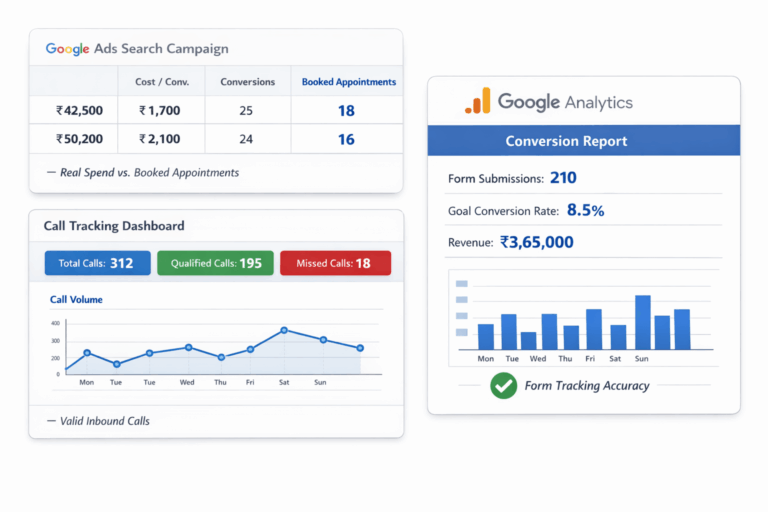
5. Track What Actually Matters
Track:
- Booked appointments
- Cost per customer
- Revenue per campaign
Not:
- Clicks
- Impressions
- Cheap lead counts
Use:
- Google Ads dashboard
- Google Analytics
- Call tracking reports
6. Optimization & Scale
Scale only when:
Cost Per Customer Is Stable
Your acquisition cost should stay within a consistent, profitable range — not fluctuate wildly every week. If one month it’s ₹2,000 and the next it’s ₹5,000, scaling is risky. Stability shows your targeting, offer, and tracking are aligned. Scale only when numbers are predictable, not when they look temporarily good.
Lead-to-Sale Ratio Is Predictable
You should know roughly how many leads convert into paying customers. For example, 1 in 5 or 1 in 8 — and that ratio should stay steady. If conversion swings randomly, something is broken in lead quality or sales process. Predictability gives you confidence to increase budget responsibly.
Backend Is Converting Consistently
Your follow-up, sales script, reminders, and operations must work smoothly before scaling traffic. If staff miss calls or delay responses, more leads won’t fix the problem. A strong backend turns marketing effort into revenue. Weak backend systems destroy ROI quietly.
Pause when:
- Cost per customer exceeds break-even
- Sales team is overwhelmed
- Follow-up quality drops
Never scale chaos.

Case Studies
Case 1: Small Physiotherapy Clinic
- Industry: Healthcare
- Monthly budget: ₹50,000
- Channel: Google Search + GBP optimization
Initial:
- 40 leads
- 8 patients
- ₹6,250 cost per patient
Problems:
- No call tracking
- Weak landing page
- Slow follow-up
After 6 months:
- 28–32 patients/month
- ₹2,100 cost per patient
- 3x ROI
What worked:
- Tight keyword filtering
- Sports injury specialization
- Faster callbacks
Lesson:
Better targeting + backend > more budget.
Case 2: Multi-Location Home Services Brand
- Locations: 5 cities
- Budget: ₹4,00,000/month
- Initial strategy: Aggressive scaling across Google & Meta.
Problems:
- Lead volume increased.
- Lead quality dropped.
- CAC increased 40%.
Mistake:
Scaled before stabilizing per-location conversion.
Correction:
- Separate campaigns per city
- Offline conversion tracking
Final:
- 18% lower CAC
- Stable monthly booked jobs
- Sustainable growth
Lesson:
Scale precision. No noise.

Testimonial
“I thought we needed more leads. Turns out we needed better filtering. Revenue grew without increasing the budget.”
— Dr. Mehul Patel, Clinic Owner (Ahmedabad)
“Our agency showed 120 leads. Only 14 were serious. After tracking booked site visits, everything changed.”
— Rajiv Sharma, Founder – Home Renovation Company
“Offline conversion tracking exposed inflated numbers. We stopped optimizing for fake KPIs.”
— Neha Verma, Marketing Head – Multi-Location Service Brand

Market Reality & Data Context
Lead costs fluctuate due to:
Competition
As more businesses bid on the same keywords or target the same audience, costs naturally increase. Your cost per lead today may not be the same next quarter. Strong competitors with better reviews, offers, or budgets can impact your performance quickly. Marketing strategy must adapt — not assume stable pricing forever.
Seasonality
Many local services fluctuate by season — renovations, real estate, AC repair, even clinics. Demand may spike in certain months and slow in others. If you don’t account for this, you might wrongly assume your ads stopped working. Seasonality affects both lead volume and conversion rates.
Platform Algorithm Updates
Google and Meta frequently adjust how ads are delivered and optimized. Targeting behavior, cost structures, and visibility can shift without warning. What worked six months ago may perform differently today. Businesses relying on one tactic without monitoring data closely often get caught off guard.
Economic Slowdowns
When consumer confidence drops, people delay non-essential spending. Even high-intent leads may convert slower during uncertain periods. This doesn’t always mean your marketing is broken — sometimes demand itself contracts. During slowdowns, focus on efficiency and retention instead of aggressive scaling.
Benchmarks change yearly.
Rely on:
- Google Ads dashboard
- Google Analytics
- Google Search Console
- Meta Ads Manager
Not blog averages.

Who This Guide Is NOT For
This is not for:
- Businesses expecting daily guaranteed leads
- Owners unwilling to fix follow-up
- Services with razor-thin margins
- Anyone chasing “cheap leads”
This guide will NOT give you:
- Viral hacks
- Platform loopholes
- Guaranteed CPL
- Overnight growth
Proof & Screenshot
Conclusion
More leads do not fix a broken system.
- Clear positioning.
- Right channel.
- Correct economics.
- Strong conversion process.
- Accurate tracking.
That’s how predictable lead flow is built. Before approving your next marketing budget:
Ask yourself:
- Do we know our real cost per customer?
- Can we respond to leads within 15 minutes?
- Are we tracking booked appointments?
- Is our offer strong enough?
- Are we ready to scale responsibly?
Use this framework before hiring your next agency.
Starting from SEO as well as local SEO to local optimization, SEO and Google Ads and social media marketing campaigns Businesses require the right mix of digital strategies to thrive in 2025. If you’re working in healthcare, real estate, F&B, or a founder of a startup digital marketing will help you:
- Attract customers.
- Create confidence.
- Scale faster than your competitors.
In the future, Ahmedabad is in the hands of companies that adopt strategies that are digital-first today.
How Local Service Businesses Can Get More Leads Online?: FAQs
Check your offer, lead intent, sales script, response speed, and pricing alignment. Conversion problems usually come from positioning or follow-up — not the ad platform itself.
If you need leads now, start with ads. If you want long-term stability, build SEO. The smartest approach is staged — ads for immediate demand, SEO for future control.
Most local campaigns take 3–6 months to stabilize and become predictable. Anyone promising consistent results in 30 days is oversimplifying real-world market dynamics.
They can generate enquiries, but margins shrink and you don’t own the customer relationship. Use them carefully, not as your primary growth engine.
Ask for booked appointment reports, revenue attribution, and offline conversion tracking proof. If they avoid revenue-level metrics, that’s a red flag.
References
About the Author