
Table of Contents
ToggleHow To Reduce Cost Per Lead In Google Ads Campaigns?
Three months ago, a founder showed me his Google Ads dashboard.
- Same campaigns
- Same keywords
- Same agency
- CPL up 62% in 4 months
The explanation he was given?
“Sir, algorithm learning phase.”
“Competition has increased.”
“We should increase the budget to stabilize CPL.”
In reality?
- Search intent had diluted
- Lead quality had collapsed
- Sales team had stopped following up half the leads
- Automation was optimising for form fills, not buyers
This is why most Google Ads blogs fail real businesses. They are:
- Too platform-friendly
- Too tool-obsessed
- Too detached from profit, sales, and reality
They talk about optimising ads. They don’t talk about whether you should be advertising at all. In my experience auditing Google Ads accounts for real businesses, CPL rarely increases because of one setting. It increases because bad decisions compound quietly.
This guide is about stopping that.

REAL BUSINESS PROBLEMS
What I see repeatedly in audits
CPL rising with no clear cause
When cost per lead increases without any obvious change in ads, keywords, or budget, it usually means hidden inefficiencies are compounding. Search intent drifts, competition increases, or automation starts chasing easier (lower-quality) conversions. The danger is not the rise itself — it’s continuing to spend without understanding what changed. Ignoring this phase almost always locks in a higher CPL permanently.
“Leads increasing” but sales conversions falling
This is one of the most expensive illusions in paid ads. Google Ads is doing its job — delivering more form fills — but the business is paying for people who were never buyers. Lead volume hides declining intent, poor targeting, or weak qualification. If sales conversions drop while leads rise, CPL becomes meaningless and CAC quietly explodes.
Agencies reporting
CTR instead of revenue
Click-through rate looks impressive in slides, but CTR does not pay salaries. High CTR often comes from curiosity clicks, not purchase intent. When agencies lead with CTR, Quality Score, or Impression Share, it usually means they are optimising for platform metrics, not business outcomes. Revenue, lead quality, and close rate are harder to show — which is exactly why they matter more.
Quality Score
Quality Score is a diagnostic signal, not a performance goal. Improving it does not guarantee better leads or lower acquisition cost. Many campaigns with excellent Quality Scores still lose money because the offer, pricing, or audience is wrong. This is where results-focused digital marketing services become critical — shifting attention from vanity metrics to real business outcomes like revenue, profitability, and customer acquisition efficiency. When Quality Score is presented as success, it often masks the absence of real profitability analysis.
Impression Share
Impression Share measures visibility, not value. A higher share simply means you’re appearing more often — sometimes to the wrong people at the wrong time. Chasing Impression Share often leads to higher bids, broader reach, and inflated CPL. Visibility without intent is just expensive noise, not growth.
Blind trust in smart bidding
Smart bidding works only when conversion data is clean, consistent, and aligned with revenue. Most accounts don’t meet that requirement. When businesses trust automation without validating lead quality, Google optimises for volume, not viability. The result is short-term stability and long-term CPL inflation.
Landing pages never questioned
Ads are blamed for high CPL far more often than they should be. In reality, conversion friction on the landing page — slow load time, weak messaging, too many fields — quietly destroys efficiency. No bidding strategy can fix a page that doesn’t persuade. Ignoring the landing page guarantees rising CPL, even with perfect ads.
Sales blaming ads, ads blaming sales
This disconnect is where money leaks fastest. Marketing measures leads, sales measures revenue — and no one owns the full funnel. Ads get accused of “bad leads”, sales get accused of “poor follow-up”, and spend continues anyway. Until both sides agree on what a good lead is, CPL optimisation is impossible.
Patterns across industries
Local services
- Broad keywords attracting price shoppers
- Call leads logged as conversions without qualification
B2B & SaaS
- Demo forms optimised without ICP filtering
- Sales teams ignoring low-quality inbound
Education & coaching
- Volume-based lead obsession
- Zero lead-to-enrolment tracking
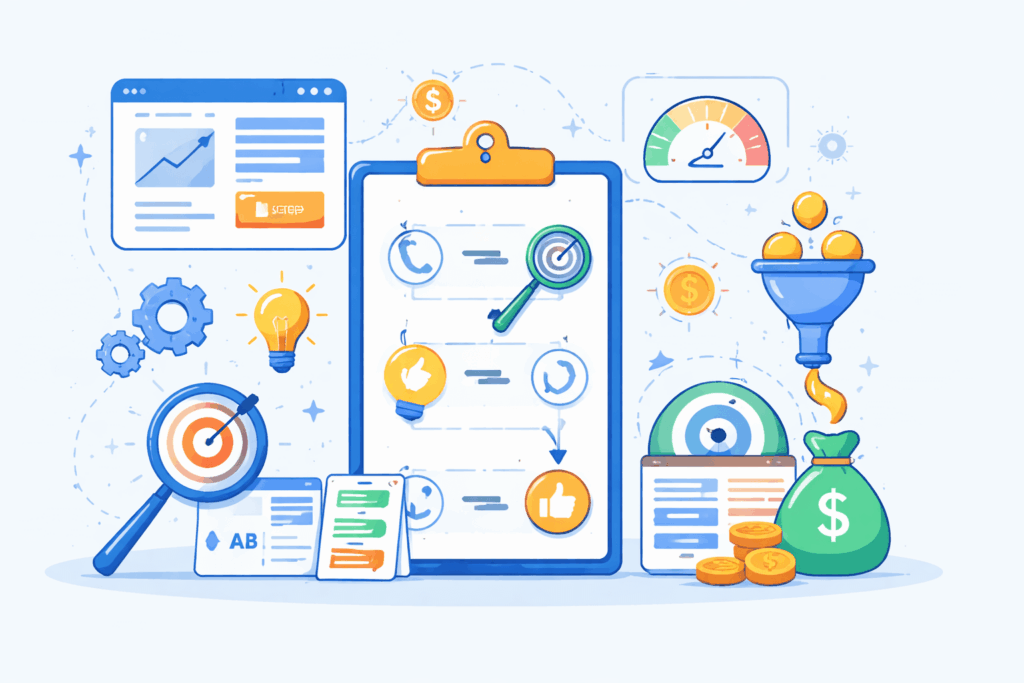
STEP-BY-STEP DECISION FRAMEWORK
Step 1: Lead Definition & Business Readiness
What to do
- Define what a qualified lead means for your business
- Separate:
- Inquiry
- Marketing lead
- Sales-qualified lead
Why it impacts CPL
If Google is optimising for any form fill, it will find the cheapest — not the best.
Mistakes to avoid
- Counting WhatsApp clicks and spam calls as leads
- “More leads = success” thinking
Audit pro tip
If sales won’t call 30% of leads, ads are not the problem.
Step 2: Campaign & Keyword Intent Alignment
What to do
- Break campaigns by intent, not services
- Separate:
- Research intent
- Comparison intent
- Buying intent
Why it impacts CPL
Mixed intent inflates CPL because high-intent searches subsidise junk traffic.
Mistakes to avoid
- Broad match without guardrails
- “Let Google find new users” mentality
Audit pro tip
Search Terms Report tells the truth — agencies rarely show it.
Step 3: Budget, Bidding & CPL Reality Check
Calculate:
Acceptable Cost Per Lead (CPL)
Acceptable CPL is the maximum amount you can pay for a lead without hurting profit. It is calculated backward from real revenue, not from Google Ads benchmarks. If your acceptable CPL is ₹800 but you’re paying ₹1,200, optimisation is irrelevant — the business model is bleeding. This number tells you when to scale, when to cap spend, and when to pause ads.
Actual Customer Acquisition Cost (CAC)
CAC is what it truly costs to acquire a paying customer, including ad spend, sales effort, and lead wastage. It exposes the gap between “cheap leads” and expensive customers. Many businesses celebrate low CPL while CAC silently rises beyond profitability. If CAC is not tracked, Google Ads decisions are based on illusion, not economics.
Align bidding strategy with sales cycle length
Short sales cycles need fast, high-intent bidding; long sales cycles require patience and cleaner data. Using aggressive smart bidding for a 30–90 day sales cycle forces Google to optimise for early signals, not final revenue. This misalignment inflates CPL and floods sales with unready leads. The bidding strategy must respect how long your buyers actually take to decide, not how fast the platform wants to optimize.
Why it impacts CPL
Smart bidding without volume or clean data increases CPL silently.
Mistakes to avoid
- Switching bidding strategies every 2 weeks
- Increasing budget to “help learning”
Audit pro tip
If CPL is above the profit threshold, pause is a strategy, not failure.
Step 4: Landing Page & Conversion Friction Audit
What to do
- Reduce fields
- Match ad promise to page headline
- Remove distractions
Why it impacts CPL
Conversion friction inflates CPL faster than CPC increases.
Mistakes to avoid
- Homepage as landing page
- Generic “Contact Us” CTAs
Audit pro tip
A bad landing page makes even perfect ads expensive.
Step 5: Tracking, Lead Quality & Attribution
What to do
- Validate conversions via:
- Google Analytics / GA4
- Google Tag Manager
- Google Analytics / GA4
- Track:
- Lead source
- Lead quality
- Time to conversion
- Lead source
Why it impacts CPL
If tracking lies, optimisation decisions lie.
Mistakes to avoid
- Duplicate conversions
- No offline conversion import
Audit pro tip
If CPL “improves” but revenue doesn’t — tracking is broken.
Step 6: Optimise vs Pause vs Scale Decisions
Be brutally honest
Sometimes CPL cannot be reduced further
Every market has a floor price for demand. Once high-intent keywords, audiences, and landing pages are already optimised, further CPL reduction becomes unrealistic. At this stage, pushing harder only sacrifices lead quality or increases volume of non-buyers. The correct decision is often to accept the CPL, change the business model, or reduce dependency on ads — not force optimisation theatre.
Sometimes pricing kills ads
Google Ads cannot fix an offer that is mispriced for the market. If competitors offer similar value at lower prices, ads will still generate clicks — but conversions collapse and CPL rises. In many audits, pricing — not targeting — is the real bottleneck. Until pricing, packaging, or perceived value is corrected, no bidding strategy will save ROI.
Sometimes sales follow-up ruins ROI
Delayed callbacks, poor qualification, or weak closing skills destroy ad efficiency silently. A lead contacted after 24 hours is already colder — even if CPL looks “healthy” in reports. When sales leaks exist, increasing ad spend only amplifies wasted cost. In such cases, fixing follow-up discipline improves ROI faster than any Google Ads change.
REAL CASE STUDIES
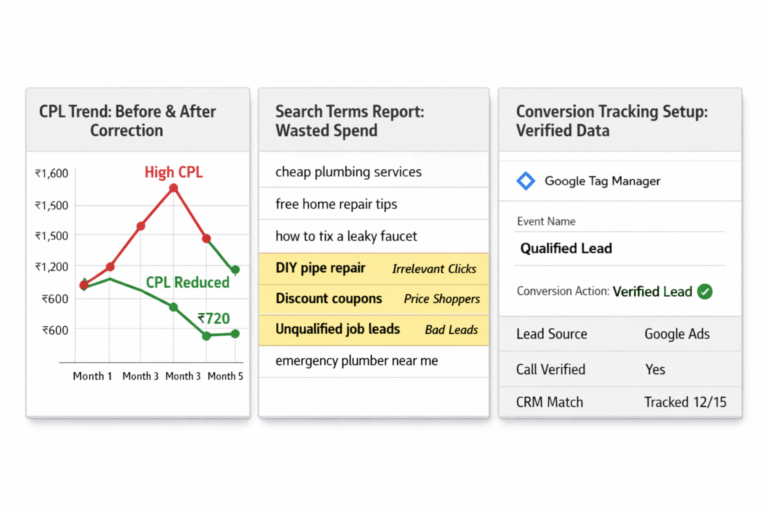
Case 1: Local Service Business
- Industry: Home renovation
- Spend: ₹80,000/month
- Initial CPL: ₹1,450
- Final CPL: ₹720
What changed
- Removed broad keywords
- Reworked landing page
- Excluded low-intent search terms
What didn’t work
Smart bidding initially increased CPL
Final lesson
Lower volume, higher intent wins.
Case 2: Scaling B2B Brand
- Industry: SaaS
- Problem: CPL stable, CAC exploding
What changed
- Separated demo vs content leads
- Imported qualified conversions
- Slowed scale intentionally
Outcome
- CPL slightly higher
- CAC reduced 28%
Final lesson
Cheap leads are often expensive customers.

SOCIAL PROOF
“We paused Google Ads for three weeks and reviewed what was actually happening after the lead came in. That pause saved more money than any so-called optimization we had done in months.”
— Rajesh Patel, Founder, Local Home Services Business
“Our cost per lead increased slightly, which initially worried management. But sales stopped pushing back on lead quality, and deal closures improved. That’s when we realised this was real progress.”
— Ankit Mehra, Marketing Head, B2B Software Company
“We stopped chasing volume and focused on intent. Leads reduced, but admissions became more consistent and predictable. For the first time, Google Ads started making sense as a business channel.”
— Neha Sharma, Owner, Education & Training Institute

VERIFIED DATA & PLATFORM CONTEXT
Google Ads auction pressure increases yearly
Every year, more advertisers compete for the same high-intent search demand, pushing bids upward. This means even well-optimised accounts experience rising CPL over time. The mistake is assuming performance decline equals mismanagement. In many cases, it reflects market saturation, not campaign failure — and requires expectation resets or channel diversification.
Automation favours higher spenders
Google’s automation systems learn faster and stabilize better with larger budgets. Accounts with limited spend feed fewer signals into the system, making smart bidding less reliable. As a result, smaller advertisers often pay a “data tax” through higher CPL. Blindly trusting automation without enough volume quietly advantages bigger competitors.
Conversion lag distorts short-term CPL
Many businesses evaluate CPL too early, ignoring the delay between click, lead, and conversion. When conversion lag exists, recent spend appears inefficient even if revenue arrives later. This leads to premature changes that destabilise performance. Without accounting for lag, short-term CPL decisions often damage long-term ROI.
PROOF & SCREENSHOT
Conclusion:
Reducing CPL is not about tricks. It’s about making fewer wrong decisions. Before you increase budget, ask:
- Is this traffic worth paying for?
- Are sales ready?
- Is the offer strong?
If you want:
- A CPL audit checklist
- A self-evaluation worksheet
- Or a second opinion before scaling
Ask — without pressure.
How To Reduce Cost Per Lead In Google Ads Campaigns?: FAQs
Because ad auctions get more competitive, search intent gets diluted, or leaks exist in your funnel. It’s rarely “bad luck” — it’s usually unaddressed structural issues compounding over time.
If your unit economics don’t work, pausing is the correct move. Spending more to “fix” unprofitable ads only locks in higher losses.
Not always — but if they avoid revenue, lead quality, or sales outcomes, be cautious. Performance without business impact is a red flag.
Yes, often — if conversion data is weak or misaligned with real buyers. Automation optimises what you feed it, not what you intend.
Expect at least 4–8 weeks with stable tracking and budgets. Faster “improvements” are usually noise, not real optimization.
Reference
About the Author