
Table of Contents
TogglePaid Ads vs Organic Marketing: What Should Businesses Choose?
A founder calls me.Revenue is unstable. Cash runway: 7 months.
An agency is pushing hard: “Just increase your ad budget. Scale what’s working.”
Meanwhile:
- Google Ads is spending ₹3–5 lakhs/month.
- CAC is rising quietly.
- Organic traffic is “growing”… but not converting.
- Pressure from investors to “scale fast.”
And the founder asks: “Should we double down on ads? Or invest in SEO and content instead?”
Most blogs comparing Paid vs Organic are useless.
They:
- List pros and cons.
- Repeat “ads are fast, SEO is long-term.”
- Ignore margins, timing, burn rate, and business stage.
- Never explain when each channel becomes dangerous.
In my experience auditing ad accounts and organic strategies for real businesses — from small local companies to scaling D2C brands — the wrong channel at the wrong time doesn’t just slow growth.
It damages cash flow. This guide is about preventing that mistake.

The Real Business Problems Behind This Decision
Myth 1: “Ads give instant results.”
ROAS Looked Healthy
On the surface, the return on ad spend (ROAS) appeared strong inside platforms like Google Ads. Revenue numbers were high compared to ad spend, creating false confidence. But ROAS only measures top-line revenue — not profitability. Partnering with a full-service digital marketing agency helps businesses connect ad performance with backend metrics like margins, customer lifetime value, and operational costs. When deeper financial analysis is missing, businesses scale based on illusion, not margin reality.
Refunds, Discounts, and Overhead Erased the Margin
After accounting for refunds, promotional discounts, payment gateway fees, and operational overhead, the actual contribution margin shrank significantly. What looked profitable in ad reports became break-even or negative in real cash flow. Many founders ignore backend costs while scaling ads. This disconnect quietly drains the runway over time.
Sales Teams Were Closing Only 30% of Leads
Lead volume was high, but conversion from lead to customer was weak — only 30%. This means acquisition cost per paying customer was far higher than reported cost per lead. When sales efficiency is low, scaling ads only amplifies inefficiency. Marketing and sales alignment becomes critical before increasing the budget.
Myth 2: “SEO is free traffic.”
It’s not free. It costs:
- Content production
- Authority building
- Time
- Opportunity cost
Inside Google Search Console audits, I’ve seen businesses:
- Generate 20,000 monthly visits
- But rank only for informational keywords
- With near-zero buying intent
Step-by-Step Decision Framework
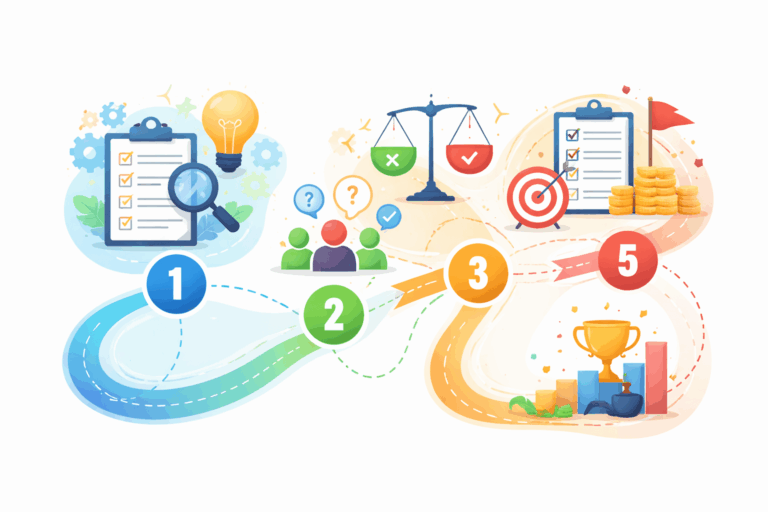
Step 1: Business Model & Unit Economics Clarity
Evaluate:
Gross Margin
Gross margin is the percentage left after deducting direct costs of delivering your product or service. It defines how much room you have to absorb marketing spend. If your gross margin is thin, aggressive paid acquisition becomes risky. Strong growth is impossible without healthy base margins.
Contribution Margin After Marketing
This is what remains after subtracting marketing costs from gross profit. It shows whether your acquisition strategy is truly sustainable. A positive contribution margin means you can scale safely; a negative one means you’re buying revenue at a loss. This is the real scaling metric — not ROAS.
Sales Cycle Length
Sales cycle length measures how long it takes to convert a lead into a paying customer. Longer cycles increase cash flow pressure, especially with paid ads. If you ignore this, you may overspend before revenue actually comes in. Marketing decisions must align with how quickly cash returns to the business.
LTV vs CAC Tolerance
LTV (Lifetime Value) vs CAC (Customer Acquisition Cost) defines how much you can afford to spend to acquire a customer. If LTV significantly exceeds CAC, scaling is viable. If the gap is small, volatility can wipe out profits. Sustainable growth requires a comfortable margin between these two numbers.
Cash Position
Your cash position determines how much risk you can take. A business with strong reserves can invest in long-term organic growth. A business with limited runway must prioritize faster feedback loops. Marketing strategy should always reflect financial reality, not ambition.
Why it matters:
If your margin is 20%, and CAC is 18%, ads will crush you at scale.
Risk of ignoring:
Scaling loss faster.If numbers don’t work, neither ads nor organic will save you.
Pro tip:
I never allow scaling until contribution margin is proven on 50+ transactions.
Step 2: Market Timing & Competitive Pressure
Evaluate:
- Is category CPC inflated?
- Are competitors VC-funded?
- Is SEO dominated by authority sites?
When NOT to run ads:
- Low margins
- No backend monetization
- Auction overheated
When organic is too slow:
- New product category
- Urgent revenue need
- No authority base
Hybrid makes sense when:
- Ads validate conversion.
- Organic builds long-term moat.
Step 3: Budget Allocation Logic
Default logic I use:
- Early validation stage: 70% Paid / 30% Organic
- Stable growth stage: 50% Paid / 50% Organic
- Authority-led brand: 30% Paid / 70% Organic
Warning signs:
- Rising CPC without CVR improvement
- Organic traffic growing but revenue flat
Step 4: Channel-Specific Risk Assessment
Paid Ads Risks
Auction Volatility
Paid advertising operates in a live bidding environment. Competitor entry, seasonal demand, or aggressive budget increases can suddenly raise costs. What was profitable last month may become unviable this month. Without close monitoring, volatility can silently erode margins.
CPC Inflation Trends in Google Ads
Cost-per-click (CPC) has steadily increased across competitive industries due to higher advertiser participation and automation-driven bidding. As auctions become crowded, acquisition costs rise even if conversion rates remain stable. If your margins don’t expand alongside CPC inflation, profitability shrinks. Scaling without tracking this trend is financially dangerous.
Policy Restrictions
Advertising platforms frequently update policies related to targeting, tracking, and industry compliance. A single policy violation can suspend campaigns or restrict reach overnight. Businesses overly dependent on one paid channel face operational risk. Diversification and compliance awareness are essential for stability.
False ROAS Confidence
ROAS can look impressive inside ad dashboards while hiding deeper financial weaknesses. It doesn’t account for refunds, operational costs, or low customer retention. Many founders scale budgets based on platform-reported performance without validating real contribution margin. True profitability must be measured beyond surface metrics.
Step 5: Tracking & Attribution Clarity
- Revenue tracking (not just leads)
- CRM integration
- Assisted conversion visibility
- Sales team feedback
If you can’t track real revenue, don’t scale either channel.
Step 6: Scale or Pause Decision
Scale Ads Aggressively When:
- CAC stable
- Contribution margin healthy
- Demand validated
Shift to Organic When:
- CAC rising
- Market saturated
- Brand authority weak
Pause Everything When:
- Sales conversion broken
- Pricing misaligned
- LTV unclear

Real Case Studies
Case Study 1 – Small Local Service Business
Industry: Home services
Budget: ₹1.5 lakh/month
Channel: Paid-first
After 6 months:
- Leads increased
- Close rate 22%
- Cash flow unstable
- CAC rising 35%
Correction:
- Reduced ad budget 40%
- Invested in local SEO + reviews
- Improved lead qualification
Result:
- Fewer leads
- Higher close rate
- Improved cash stability
Lesson: Execution and sequencing mistake — not channel failure.
Case Study 2 – Scaling D2C Brand
Started organic-first:
- Authority blog
- SEO category pages
- Influencer UGC
After 12 months:
- 40% traffic organic
- Branded search increased
CAC dropped 28% because:
- Brand familiarity improved CVR
- Retargeting stronger
Lesson: Channel sequencing matters more than channel choice.

Realistic Testimonials
“We were about to double the ad budget. The audit showed our margins couldn’t handle it.”
– Rohit Mehra, SaaS Founder
“Our SEO agency showed traffic graphs. Revenue didn’t move for 8 months.”
– Priya Kapoor, Marketing Head
“Reducing ads felt scary, but stabilizing cash flow saved us.”
– Amit Desai, Local Business Owner
Market Context & Data Reality
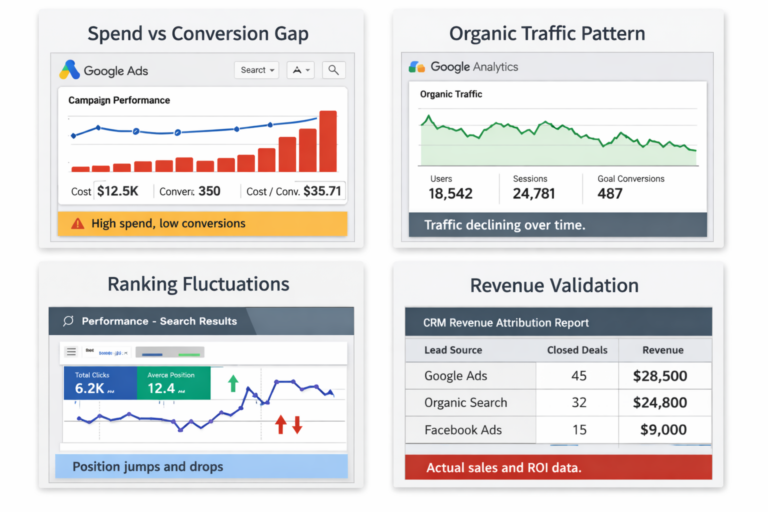
CPCs Have Risen Across Competitive Industries Inside Google Ads Auctions
As more advertisers compete for the same keywords, auction pressure naturally drives up cost-per-click (CPC). Automation and smart bidding have intensified this competition, especially in high-intent categories. Even if conversion rates stay constant, rising CPCs shrink margins. Businesses that don’t regularly reassess unit economics risk scaling into reduced profitability.
Privacy Changes Reduced Attribution Clarity
Platform and browser privacy updates have limited tracking visibility across channels. This makes it harder to accurately measure customer journeys and assisted conversions. As attribution becomes less precise, reported ROAS may not reflect real performance. Businesses must rely more on blended revenue data and CRM validation.
Algorithm Volatility Continues in the Google Search Ecosystem
Frequent core updates impact rankings across industries, sometimes without warning. Sites can gain or lose traffic significantly based on shifting quality signals. Heavy dependence on SEO without diversification increases business risk. Sustainable organic growth requires authority, brand strength, and adaptable content strategy.
Proof & Screenshot
Conclusion:
Before choosing Paid or Organic, answer:
- Do I know my real contribution margin?
- Is CAC comfortably sustainable?
- Can I track revenue, not just leads?
- Do I have a runway for organic to mature?
- Am I scaling based on profit or pressure?
Paid and Organic are tools. Timing, sequencing, and financial discipline decide outcomes.
No hacks. No guarantees. Just disciplined decision-making.
Paid Ads vs Organic Marketing: FAQs
Only if SEO generates no commercial value and immediate revenue is critical. Otherwise, maintain both for balance.
Keep organic marketing as a safety net while scaling ads cautiously.
No — consistent content and authority-building are essential for sustainable results.
Usually 6–12 months in competitive markets; patience is key.
Measure real revenue via CRM, close rates, and refunds — not just clicks or ROAS.


