

Table of Contents
ToggleWhat SEO Tactics No Longer Work With AI Search?
For years, SEO worked like a checklist.
- Find keywords.
- Write pages around them.
- Build links.
- Wait.
And for a long time, that did work — just like buying any flat near a “proposed road” used to feel safe.But search has changed.
AI-driven search engines no longer reward mechanical optimization. They reward real understanding, real usefulness, and real-world authority.
From hands-on SEO work across local businesses, service brands, and lead-driven websites, I can say this clearly:
Most SEO failures today aren’t because people don’t do SEO — they’re because they’re doing outdated SEO. Let’s break down what no longer works, why it fails in AI search, and what smart businesses are doing instead.
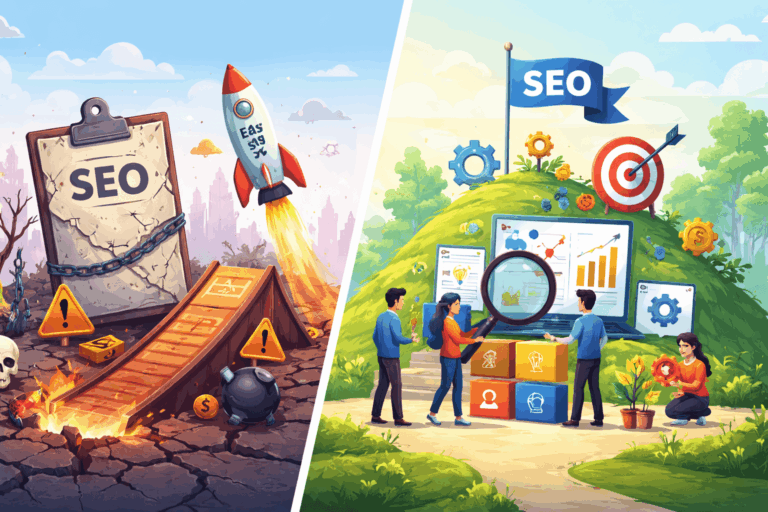
SEO Isn’t Dead — Shortcut SEO Is
Every few years, someone announces “SEO is dead.” What they really mean is:
“The tricks I relied on no longer give results.”
AI search systems (Google’s SGE, Bing Copilot, voice assistants, and LLM-powered discovery) don’t look at pages the way humans used to optimize them.
They evaluate:
Intent Satisfaction
This measures whether your content actually answers why someone searched, not just what they typed. AI evaluates if users find clarity, take action, or stop searching after visiting your page. If visitors bounce back to search results, intent wasn’t satisfied. Pages that resolve doubts, compare options, and guide decisions perform better than keyword-heavy content.
Topical Depth
Topical depth means covering a subject completely, not superficially. Instead of touching one angle, strong content explains related concepts, risks, comparisons, and next steps in one place. AI prefers pages that reduce the need for multiple searches. Deep content signals expertise, experience, and authority — not just awareness.
Behavioral Signals
These are real user actions like time spent on page, scroll depth, repeat visits, and engagement. AI systems use these signals to judge content usefulness beyond rankings. If users read, interact, and stay longer, it indicates trust and relevance. Poor behavior metrics tell AI that the content didn’t deliver value.
Real-World Credibility
Real-world credibility comes from proof — experience, examples, results, reviews, and mentions outside your website. AI cross-checks whether a brand or author is recognized beyond their own content. Case studies, local references, testimonials, and consistent brand mentions strengthen trust. Claims without proof carry little weight today.
Consistency Across the Web
This refers to how consistently your brand, expertise, and messaging appear across platforms. AI compares your website, Google Business Profile, reviews, social profiles, and citations. Mismatched details or weak presence dilute trust. Consistency reinforces legitimacy and helps AI validate your authority.

SEO Tactics That No Longer Work With AI Search
1. Keyword-Stuffed Pages Built Only to Rank
What people still do
- One page = one keyword
- Repeat the phrase unnaturally
- Write thin content just to “cover” keywords
Why this fails now
AI models understand meaning, not repetition. They can tell when a page exists only to target a term, not solve a problem.
I’ve personally seen pages with:
- Perfect keyword density
- Clean on-page SEO
- Zero real engagement
What works instead
- Topic-first content, not keyword-first
- One strong page that answers all related questions
- Natural language that mirrors how real people search
2. Backlinks Built for Quantity, Not Credibility
What people still do
- Buy guest posts
- Spam directories
- Build links without relevance
Why AI search ignores this
AI doesn’t just count links — it evaluates:
- Context
- Source credibility
- Brand consistency
- Real-world mentions
A backlink from a weak, irrelevant site now carries close to zero value, sometimes even negative value.
What works instead
- Fewer, stronger, context-rich links
- Local authority signals
- Brand mentions even without links
3. Writing for Search Engines, Not Users
What people still do
- Generic intros
- No opinions
- No experience
- No real answers
AI search systems surface content that feels human, not safe. If your article could have been written by anyone, it won’t be trusted by anyone — including AI.
What works instead
- Clear opinions
- Real examples
- “Here’s what usually goes wrong” insights
- Pros, cons, risks, and decisions
Just like property advice: buyers trust consultants who warn them, not flatter them.
4. Ignoring User Intent Shifts (Especially Voice & Conversational Search)
People no longer search like this:
- “best seo services price”
They search like this:
- “Is SEO still worth it for a local business in 2025?”
AI search prioritizes answers, not pages.
If your content doesn’t directly respond to:
- Questions
- Doubts
- Comparisons
- Next steps
What works instead
- FAQ-style sections
- Conversational headings
- Decision-based explanations
- Clear next actions
5. Static Content That Never Evolves
Old mindset
Publish once
Forget it
New reality
AI rewards freshness, updates, and adaptability. Search engines now track:
- Engagement changes
- Content updates
- Behavioral improvements
What works instead
- Regular content updates
- Adding new insights as markets change
- Expanding pages instead of creating dozens of thin ones

What AI Search Actually Rewards Today
From real-world SEO campaigns, here’s what consistently works:
1. Demonstrated Experience (Not Claimed Expertise)
Language Patterns
AI analyzes how naturally content is written and whether it reflects real human thinking. Experienced writers use contextual phrases, nuanced explanations, and balanced opinions instead of rigid templates. Over-optimized or robotic language signals low authenticity. Natural, conversational writing increases trust and perceived expertise.
Specific Examples
Examples show that knowledge comes from real experience, not theory. AI favors content that references actual scenarios, outcomes, mistakes, or lessons learned. Concrete examples reduce ambiguity and improve intent satisfaction. Vague claims without illustration are increasingly ignored.
Consistency Across Content
Consistency means your tone, expertise level, opinions, and facts align across all pages. AI checks whether your guidance contradicts itself or feels stitched together. When content supports a unified perspective, trust strengthens. Inconsistent messaging weakens topical authority and credibility.
2. Topical Authority, Not Isolated Pages
One strong topic cluster beats 20 disconnected blog posts. Example:
Instead of:
- “What is SEO”
- “SEO benefits”
- “SEO tools”
Create:
- One deep guide
- Supporting articles
- Internal linking with logic
3. Behavioral Proof
AI looks at:
- Time on page
- Scroll depth
- Return visits
- Engagement patterns
If users don’t stay, AI won’t promote you.

Step-by-Step: How to Adapt Your SEO for AI Search
Step 1: Audit What’s Actually Helping Users
- Which pages get engagement?
- Which pages feel thin?
- Which pages answer real questions?
Delete or merge weak content.
Step 2: Rewrite Core Pages With Intent in Mind
Ask:
- Why would someone search this?
- What decision are they trying to make?
- What fears or confusion do they have?
Then write for that, not keywords.
Step 3: Add Proof Everywhere
- Case examples
- Results (even small ones)
- Local references
- Screenshots, data, timelines
Trust beats optimization.
Step 4: Optimize for Conversations, Not Queries
- Use natural language
- Add FAQs
- Answer follow-up questions inside the content
This helps with AI snippets and voice search.
Step 5: Build Brand Signals Outside Your Website
- Google Business Profile
- Reviews
- Local mentions
- Consistent NAP
- Social proof
AI connects dots across platforms.

Real Case Snapshot
Problem
Local service website ranking dropped despite “good SEO”.
Issue
- Thin keyword pages
- Generic content
- Low engagement
Action
- Consolidated pages
- Added real client problems & answers
- Improved local authority signals
Result
- Fewer pages
- Higher engagement
- More leads from fewer rankings

The Real Truth About SEO in the AI Era
SEO hasn’t disappeared. Lazy SEO has. AI search is brutally honest:
If your content helps, it survives
Content that genuinely helps users answer real questions, reduces confusion, and supports decision-making. AI systems detect usefulness through engagement, intent satisfaction, and follow-up behavior. Helpful content earns trust over time and continues to surface even as algorithms change. Value creates longevity.
If it exists only to rank, it fades
Content created solely for rankings lacks depth, originality, and user focus. AI quickly identifies pages that add no new insight or experience. Low engagement and weak behavioral signals cause these pages to lose visibility. Optimization without usefulness has a short lifespan.
Conclusion:
If you want to win in AI-driven search:
- Stop chasing tricks
- Start solving problems
- Write like a practitioner, not a marketer
- Build trust before traffic
The brands that adapt now won’t just rank — they’ll own visibility in the next phase of search.
What SEO Tactics No Longer Work With AI Search?: FAQs
Tactics like keyword stuffing, thin content, bulk backlink building, and writing only for rankings no longer work. AI search prioritizes intent satisfaction, depth, and real usefulness over mechanical optimization.
AI understands context and intent, not just keywords. Pages that repeat phrases without fully answering user questions fail to engage users and lose visibility in AI-driven results.
Yes, but only high-quality, relevant, and credible links matter. AI ignores spammy or paid links and values real-world mentions, brand authority, and contextual relevance instead.
AI looks at behavioral signals like time on page, engagement, and satisfaction, along with topical depth and consistency. Content that genuinely helps users is rewarded long-term.
Focus on user-first content, topical authority, real examples, and trust signals. SEO today is about solving problems clearly, not gaming algorithms.
References
About the Author

Mitesh Vyas
Hi, I’m Mitesh Vyas, an SEO Specialist with 7+ years of hands-on experience in helping businesses grow through organic search. I focus on creating SEO strategies that not only rank but also drive real business growth.
I specialize in Technical SEO, On-Page Optimization, High-Quality Link Building, and Local SEO strategies that drive measurable rankings and revenue.
I have worked with startups, local businesses, and agencies to improve search visibility, increase website traffic, and generate qualified leads using Google-compliant, white-hat SEO practices.


