
Table of Contents
ToggleSEO Tips to Boost Your Website Traffic
Over the last decade, I’ve worked with local service businesses, property consultants, and regional brands who all asked the same question:
Why does my website exist, but traffic and inquiries don’t?
Ans: Your site likely looks fine, but it isn’t solving a specific problem for a specific search intent. When pages try to appeal to everyone, they end up relevant to no one. Search engines don’t see strong relevance, and users don’t see a clear reason to act.
In most cases, the problem wasn’t effort. It was misaligned SEO—optimizing for search engines instead of how real people search, evaluate, and decide.
This guide breaks down practical SEO tips that boost website traffic AND attract the right visitors, not just random clicks.
First: Understand What “More Traffic” Really Means
Before diving into tactics, let’s be honest:
Traffic without intent is useless
Visits mean nothing if users aren’t trying to solve a real problem. Intent-driven traffic is what converts.
Rankings without trust don’t convert
Being visible isn’t enough if users don’t believe you. Trust turns rankings into results.
SEO without clarity wastes time
If your message is unclear, users leave even if you rank. Clarity is what makes SEO work.
1. Start With Buyer Intent, Not Keyword Volume
One of the biggest SEO mistakes I see is chasing high-volume keywords that don’t match buyer mindset.
Real-world example
- “apartments in Ahmedabad” → browsing
- “ready-to-move flats in Gota price” → buyer intent
What to do:
- Identify problem-aware keywords
- Target solution-focused keywords
- Balance informational + decision-stage keywords
Expert opinion:
A keyword with 200 searches that converts beats a keyword with 20,000 searches that doesn’t.
2. Fix the #1 Traffic Killer: Poor Content Direction
Many websites publish content without a clear purpose.
Ask this before publishing anything:
Who is this for?
It’s for people actively trying to solve a specific problem and make an informed decision. Especially useful for buyers comparing options or evaluating services.
What problem does it solve?
It removes confusion by providing clear, experience-backed answers. The content helps users understand their choices and risks.
What should the reader do next?
Take a clear, low-friction next step based on their stage—review details, request help, or move forward with confidence.
Content that boosts traffic long-term:
- Step-by-step guides
- Comparison-based articles
- FAQs based on real customer questions
- “Mistakes to avoid” content
From experience:
Pages that clearly answer objections rank longer than pages stuffed with keywords.
3. Build Content Like a Local Authority
Search engines trust depth and consistency, not one-off articles.
What works:
Cover one topic completely
Focus each page on solving one specific problem in depth. Complete coverage builds relevance and authority.
Link related articles together
Connect supporting content to guide users and show topical depth. Internal links improve understanding and SEO.
Update content regularly
Refresh information to stay accurate and competitive. Updates signal relevance to both users and search engines.
This is similar to real estate trust:
The agent who knows the entire area wins, not the one listing one property.
Practical action:
Create topic clusters
- One main guide (pillar page)
- Supporting articles answering sub-questions
- Internal links connecting them
Read More: What is SEO & How It Works
4. On-Page SEO That Improves Readability, Not Just Rankings
On-page SEO should make content easier to understand.
Focus on:
One clear H1
Use a single, focused H1 that matches the main search intent. This sets context for both users and search engines.
Logical H2 and H3 sections
Break content into clear, structured sections. Logical hierarchy improves readability and understanding.
Short paragraphs
Keep paragraphs concise to maintain attention. Short blocks make content easier to read on all devices.
Bullet points for scanning
Use bullets to highlight key information quickly. This helps users scan and find answers fast.
Keywords placed naturally
Integrate keywords where they fit contextually. Natural placement improves relevance without harming readability.
Common mistake:
Over-optimizing titles and forgetting click appeal.
Good SEO titles = clarity + curiosity, not keyword repetition.
5. Page Speed: Traffic Leaves Before It Reads
If your site loads slowly, SEO efforts collapse silently.
Proven speed improvements:
Compress images
Reduce image file sizes without losing quality. Smaller images load faster and improve page speed.
Remove unnecessary plugins/scripts
Eliminate unused or heavy scripts that slow down pages. Fewer resources mean better performance.
Use caching and CDN
Caching speeds up repeat visits, while a CDN delivers content faster globally. Both reduce load time and server strain.
Choose reliable hosting
Good hosting ensures faster response times and stability. Hosting quality directly affects site speed and uptime.
Real example:
A local business saw traffic grow without new content—just by improving load time and mobile UX.
Read More: How to Choose the Best SEO Services in Ahmedabad (A Practical, Experience-Based Guide)
Mini Case Example: Traffic That Converts
Business: Local service website
Issue: Traffic but no inquiries
Changes made:
Rewrote content for buyer intent
Content now directly matches what users are actually looking to solve. This improves relevance and engagement.Marketing at home may sound appealing, however professionals have the necessary knowledge.
Added FAQs based on real questions
FAQs address genuine buyer doubts and objections. They reduce hesitation and build trust.
Improved mobile speed
Faster mobile performance improves user experience and retention. Speed supports both rankings and conversions.
Fixed internal linking
Pages are now logically connected to guide users and signal topical authority. This improves navigation and SEO.
Result:
- Lower bounce rate
- Higher engagement
- More qualified leads
- Sustainable traffic growth
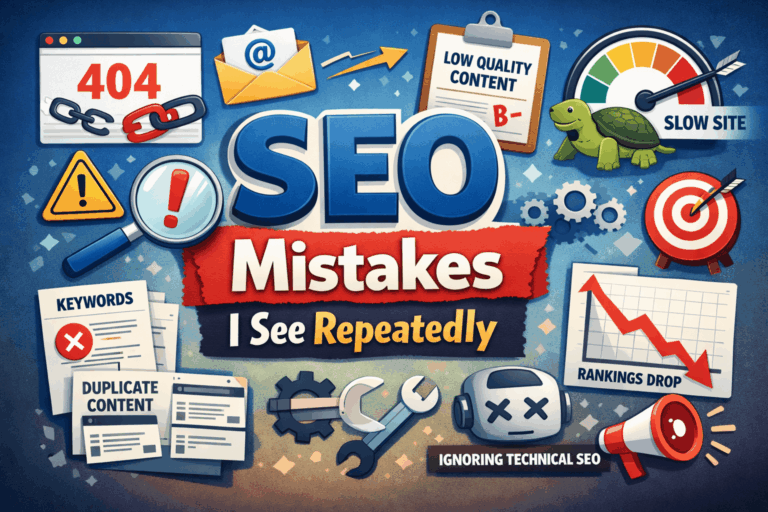
SEO Mistakes I See Repeatedly
Writing for algorithms, not users
Content optimized only for keywords fails to engage or convert. Search engines now reward usefulness and clarity.
Ignoring mobile experience
Poor mobile usability drives users away. Mobile experience directly impacts rankings and satisfaction.
Chasing volume over intent
High traffic without buyer intent doesn’t produce results. Intent-driven content attracts qualified users.
Publishing without structure
Unclear layout confuses readers and search engines. Strong structure improves readability and understanding.
Conclusion
Strong SEO behaves like a prime real estate asset:
Quality SEO content gains value as visibility and trust grow. Results improve without proportional increases in cost.
Consistent, experience-backed content positions you as a credible expert. Authority strengthens rankings and buyer confidence.
Organic search delivers steady, high-intent traffic. This reduces reliance on paid channels.
Each improvement strengthens the next. Over time, SEO creates sustained growth rather than short-term spikes.
SEO Tips to Boost Your Website Traffic - FAQs
Q1. How long does SEO take to boost traffic?
Q2. Can SEO still work with AI search tools?
Q3. Should I focus on blogs or service pages?
Q4. Is SEO better than paid ads?
Q5. How often should content be updated?
References
About the Author