
Table of Contents
ToggleDigital Marketing Strategy for Small Businesses In India
Running a small business in India is no longer only about having a good product or providing excellent service. Your potential customers are searching on Google, checking reviews, comparing businesses on social media, watching videos, and contacting businesses through WhatsApp before making a decision.
This is why having a digital marketing strategy for small businesses in India has become increasingly important.
But digital marketing does not mean being active on every platform or spending a large amount of money on advertising.
For a small business, the better approach is to identify where your customers are searching, build trust before asking for a sale, and invest your limited marketing budget in channels that can realistically generate enquiries and sales.
This guide explains how small businesses in India can build a practical digital marketing strategy using SEO, local SEO, Google Business Profile, Google Ads, social media marketing, content marketing, WhatsApp and conversion-focused website optimisation.
What Is a Digital Marketing Strategy for a Small Business?
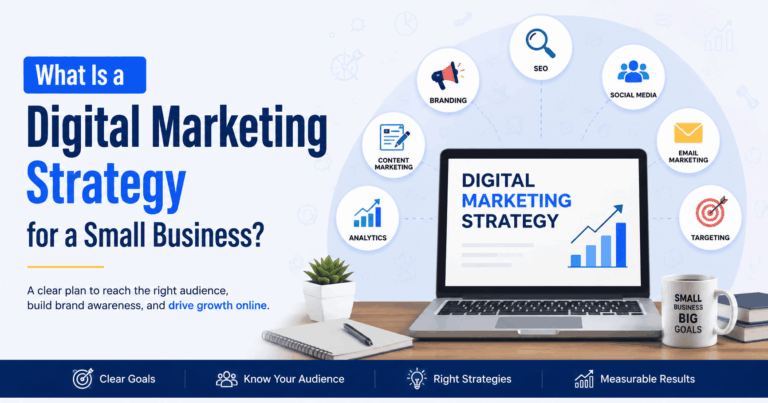
A digital marketing strategy is a planned approach to attracting potential customers through online channels and converting them into enquiries, customers or repeat buyers.
Instead of randomly posting on Instagram or running advertisements, a strategy answers questions such as:
- Who is your ideal customer?
- What problem are they trying to solve?
- Where do they search for businesses like yours?
- What keywords do they use?
- Which marketing channel should you prioritise?
- How much should you spend?
- What should your website communicate?
- How will you measure leads and sales?
For example, a local physiotherapy clinic, an interior designer, a restaurant and an online clothing store should not use the same marketing strategy.
Their customers search differently, their buying journeys are different, and their conversion methods are different.
The best digital marketing strategy is therefore not the one that uses the most channels. It is the one that connects the right audience with the right offer through the right channel.
Why Digital Marketing Is Important for Small Businesses in India
Digital marketing gives small businesses an opportunity to compete for attention without requiring the marketing budgets of large companies.
A local business can potentially appear in Google Search, Google Maps, social media platforms and other online channels when customers are actively looking for its products or services.
India’s digital ecosystem also provides businesses with increasingly accessible digital commerce and payment infrastructure. Government data published in 2026 states that UPI serves more than 55 crore individuals and 6.5 crore merchants, while UPI accounted for 85% of India’s digital payment transactions by volume in FY 2025–26.
For small businesses, the important lesson is not simply that people use digital payments.
It is that customers are increasingly comfortable discovering businesses, communicating with them and completing transactions through digital channels.
Digital marketing can help a small business:
- Increase online visibility
- Generate targeted enquiries
- Reach customers in specific cities or areas
- Build brand credibility
- Generate organic traffic through SEO
- Promote products and services
- Retarget interested customers
- Build long-term customer relationships
- Measure marketing performance
However, visibility alone does not create revenue.
Your marketing strategy needs to connect visibility with a clear offer, strong trust signals and an easy conversion process.
10-Step Digital Marketing Strategy for Small Businesses in India
1. Define Your Target Customer Before Marketing
One of the biggest mistakes small businesses make is trying to market to everyone.
Before choosing a marketing channel, define your ideal customer.
Ask:
- What age group are they in?
- Where do they live?
- What problem do they have?
- What solution are they looking for?
- How urgently do they need it?
- What questions do they ask before buying?
- What factors influence their decision?
- What competitors are they considering?
For example, imagine a small home interior design company in Ahmedabad.
Its target audience may be:
Homeowners aged 28–50 who are renovating or furnishing a new apartment and are looking for interior design services in Ahmedabad.
That audience is much more useful than simply saying:
“People interested in interiors.”
Once you understand the customer, you can build content, landing pages, advertisements and offers around their actual needs.
2. Build a Professional, Mobile-Friendly Website
Your website should be the foundation of your digital marketing strategy.
Social media profiles are useful, but you do not control the platform, its algorithms or how your business information is presented.
Your website gives you a central place to explain:
- Who you are
- What you offer
- Who you serve
- Why customers should trust you
- How your service works
- What your products or services cost, when appropriate
- How customers can contact you
Your website should include:
- Clear homepage messaging
- Individual service or product pages
- Contact information
- WhatsApp or enquiry option
- Strong calls to action
- Customer reviews or testimonials where appropriate
- About page
- Frequently asked questions
- Location information for local businesses
- Useful educational content
It should also work properly on mobile devices.
A visitor who finds your business through Google but struggles to understand what you offer or how to contact you may simply leave and choose another business.
3. Use SEO to Build Long-Term Organic Visibility
Search engine optimisation (SEO) should be one of the core components of a long-term digital marketing strategy for small businesses in India.
SEO helps your website become more visible when potential customers search for relevant products, services and information.
For example:
- Digital marketing agency in Ahmedabad
- Best accounting software for small businesses
- Wedding photographer in Surat
- Home tutor in Vadodara
- Dental clinic near me
- Handmade furniture in Jaipur
Instead of targeting only broad keywords, small businesses should also look for specific searches that indicate strong customer intent.
A practical SEO strategy includes:
- Keyword research
- Search intent analysis
- Service and product page optimisation
- Local SEO
- Helpful blog content
- Internal linking
- Technical SEO
- Image optimisation
- Website speed and mobile usability
- Building relevant authority and mentions
Google recommends creating helpful, reliable, people-first content rather than producing pages primarily to manipulate search rankings. It also recommends using words that people actually search for in prominent and descriptive locations on the page.
That means your SEO strategy should start with the customer—not keyword density.
4. Focus on Local SEO If You Serve a Specific Area
Local SEO can be particularly valuable for businesses that serve customers in specific cities, neighbourhoods or geographic areas.
Examples include:
- Restaurants
- Clinics
- Salons
- Real estate businesses
- Coaching institutes
- Lawyers
- Home service providers
- Repair businesses
- Local retailers
- Consultants
- Fitness centres
A properly maintained Google Business Profile can help your business appear in relevant local searches and Google Maps.
Optimise your local presence by:
- Keeping business information accurate
- Selecting appropriate business categories
- Adding relevant services
- Uploading genuine business photographs
- Maintaining correct opening hours
- Responding to customer reviews
- Publishing useful updates where appropriate
- Keeping your website and business information consistent
Reviews can also influence how potential customers perceive your business.
Do not try to manufacture reviews. Instead, create a straightforward process for genuinely satisfied customers to share their experience.
5. Create Content Around Customer Questions
Blogging should not mean publishing random articles simply because a keyword has search volume.
Instead, create content around questions your customers actually ask.
For example, a small accounting firm could publish:
- How to choose an accountant for a small business
- GST mistakes small businesses should avoid
- How much does bookkeeping cost in India?
- When should a small business hire an accountant?
- Bookkeeping vs accounting: What’s the difference?
A digital marketing agency could publish:
- How much should a small business spend on digital marketing?
- SEO vs Google Ads: Which is better for a small business?
- How long does SEO take to generate leads?
- How to generate local leads from Google
- Common digital marketing mistakes small businesses make
This type of content can attract people at different stages of the buying journey.
A useful content structure is:
Problem → Explanation → Options → Practical advice → Next step
This is more valuable than repeatedly inserting the same keyword into generic paragraphs.
6. Choose Social Media Based on Your Customers
Being present on every social media platform is not necessary.
Instead, identify where your target customers actually spend their time.
Useful for businesses where visual content matters, such as:
- Fashion
- Beauty
- Food
- Fitness
- Travel
- Interior design
- Events
- Lifestyle products
Can be more useful for:
- B2B businesses
- Consultants
- Technology companies
- Professional services
- Recruitment
- Business-to-business service providers
YouTube
Useful when your products or services can be explained through demonstrations, tutorials, comparisons or educational videos.
Can still be useful for particular local communities, customer groups and advertising campaigns depending on the audience.
The important principle is:
Do not choose a platform because everyone else is using it. Choose it because your customers are there.
7. Use WhatsApp as a Conversion Channel
For many Indian small businesses, WhatsApp can become an important part of the customer journey.
Instead of forcing a potential customer to navigate several pages, businesses can provide a simple way to ask questions, request information or begin an enquiry.
Depending on the business, WhatsApp can support:
- Enquiries
- Appointment requests
- Product questions
- Price discussions
- Order updates
- Customer support
- Follow-ups
- Repeat purchases
However, WhatsApp should not become a channel for unwanted bulk messages.
Use it responsibly and communicate with customers who have a legitimate reason to hear from your business.
8. Use Google Ads When You Need Faster Visibility
SEO can take time.
If your business needs qualified enquiries sooner, Google Ads can be useful because you can target searches that show commercial intent.
For example:
“AC repair service near me”
is generally much closer to a buying decision than:
“How does an air conditioner work?”
The first search may represent someone actively looking for a service.
The second may simply be informational.
For a small business, start carefully.
Instead of launching multiple campaigns for every possible keyword, identify a small group of high-intent searches.
Then create:
Keyword → Ad → Landing Page → Enquiry → Follow-up
This makes it easier to understand where your advertising budget is going.
Do not judge Google Ads only by clicks.
Track:
- Leads
- Qualified leads
- Calls
- WhatsApp enquiries
- Appointments
- Sales
- Cost per lead
- Cost per acquisition
- Revenue generated
A campaign that receives thousands of clicks but produces no customers is not necessarily successful.
9. Use Meta Ads Strategically
Facebook and Instagram advertising can be useful when your business needs to reach people based on interests, demographics, behaviour or previous interactions.
Meta advertising can work particularly well for products and services where visual presentation and awareness influence the buying decision.
Examples include:
- Fashion
- Beauty
- Food
- Education
- Fitness
- Events
- Home décor
- Lifestyle products
But social advertising and search advertising serve different purposes.
Someone searching Google for:
“buy office chairs online”
has demonstrated active intent.
Someone seeing an office-chair advertisement while scrolling Instagram may not have been planning to buy one.
Therefore, your advertising message should reflect the difference.
10. Measure Leads and Sales, Not Vanity Metrics
A small business cannot afford to spend money without knowing what happened afterward.
Likes, impressions and followers may be useful indicators, but they are not the final business outcome.
Your reporting should answer questions such as:
- How many enquiries did we receive?
- Where did they come from?
- How many became customers?
- Which service generated the most leads?
- Which keyword generated enquiries?
- Which advertisement generated sales?
- What was the cost per qualified lead?
- What was the return on marketing spend?
For example:
Marketing Channel | Main Goal | Important Metric |
SEO | Organic visibility | Qualified organic leads |
Local SEO | Local customers | Calls, directions, enquiries |
Google Ads | Immediate demand | Cost per qualified lead |
Awareness & engagement | Leads, enquiries, conversions | |
Communication | Qualified conversations | |
Content Marketing | Education & trust | Organic traffic and assisted conversions |
Retention | Repeat purchases and conversions |
This shifts the focus from “How many people saw us?” to “What did our marketing actually produce?”
Read More:- How Digital Marketing Improves Brand Visibility?
SEO vs Google Ads vs Social Media: What Should a Small Business Choose?
There is no universal answer.
The right combination depends on your business model.
Channel | Best For | Time Horizon |
SEO | Sustainable organic traffic | Medium to long term |
Local SEO | Local service businesses | Medium to long term |
Google Ads | High-intent searches | Short term |
Visual businesses and brand awareness | Short to medium term | |
Facebook Ads | Targeted awareness and lead generation | Short to medium term |
Content Marketing | Education and authority | Medium to long term |
Enquiries and customer communication | Immediate | |
Email Marketing | Retention and repeat sales | Medium to long term |
A common mistake is trying to do all of these simultaneously.
A better approach is to choose one primary acquisition channel and one supporting channel, build a repeatable process, measure results and expand after you understand what works.
How Much Should a Small Business Spend on Digital Marketing in India?
There is no fixed digital marketing budget that works for every business.
A business with a high-value service and a strong profit margin can potentially justify a larger customer-acquisition budget than a business selling low-margin products.
Instead of asking:
“How much should I spend on digital marketing?”
start with:
“How much can I profitably spend to acquire one customer?”
For example, suppose:
- Average customer value = ₹20,000
- Gross profit from customer = ₹8,000
- Maximum acceptable acquisition cost = ₹2,500
Your marketing strategy can then be evaluated against that business reality.
This is more useful than copying another company’s monthly marketing budget.
A Simple 90-Day Digital Marketing Plan for Small Businesses
If you are starting from scratch, you do not need to implement everything at once.
Days 1–30: Build the Foundation
Focus on:
- Define your target audience
- Identify your main products or services
- Analyse competitors
- Research customer search terms
- Improve your website
- Set up or optimise Google Business Profile
- Add clear contact and enquiry options
- Set up analytics and conversion tracking
- Create a basic content plan
The objective is to create a reliable foundation.
Days 31–60: Start Attracting the Right Audience
Focus on:
- Publish useful SEO content
- Optimise service pages
- Build local citations where relevant
- Collect genuine customer reviews
- Start consistent social media content
- Test one paid advertising channel if appropriate
- Improve landing pages
- Track leads and enquiries
At this stage, you should begin identifying which channels show genuine potential.
Days 61–90: Measure and Improve
Now look at the data.
Identify:
- Best-performing keywords
- Highest-converting pages
- Best-performing advertisements
- Most valuable customer segments
- Cost per qualified lead
- Conversion rate
- Most effective content
- Weak points in the customer journey
Then allocate more resources to what is working.
Do not continue spending simply because a campaign has already received money.
Common Digital Marketing Mistakes Small Businesses Should Avoid
1. Trying to Be Everywhere
Being active on six platforms does not help if none is managed properly.
2. Spending on Ads Before Fixing the Website
Advertising can bring visitors, but a poor website can waste those visitors.
3. Focusing Only on Followers
A business can have thousands of followers and still struggle to generate sales.
4. Ignoring Local SEO
If you serve customers in a particular city, local search visibility can be extremely valuable.
5. Publishing AI-Generated Content Without Expertise
AI can help with research and drafting, but generic content without original insight can make a website less useful.
Google specifically encourages people-first content that demonstrates appropriate expertise and provides substantial value beyond simply rewriting information found elsewhere.
6. Targeting Only Broad Keywords
Highly competitive keywords can consume resources without generating enough qualified leads.
Specific, high-intent searches may be more useful for a small business.
7. Not Tracking Conversions
Without conversion tracking, you cannot reliably determine which marketing activities are producing business results.
8. Expecting Instant SEO Results
SEO is generally a long-term investment. It requires useful content, technical foundations, relevance, authority and ongoing improvement.
How Small Businesses Can Compete With Larger Companies Online
You do not necessarily need to beat a large company everywhere.
Instead, become highly relevant to a specific audience.
For example, rather than targeting:
Digital Marketing Agency
a smaller agency might build authority around:
Digital Marketing for Small Businesses in Ahmedabad
or:
Digital Marketing for Local Service Businesses in India
The more specific your positioning, the easier it becomes to create relevant content and communicate a clear value proposition.
Small businesses can compete through:
- Local expertise
- Industry specialisation
- First-hand experience
- Better customer service
- Useful educational content
- Strong reviews
- Faster communication
- Specific solutions
- Strong topical authority
Being smaller can be an advantage when you are more relevant.
The Future of Digital Marketing for Small Businesses in India
Digital marketing is becoming more connected.
Customers may discover a business through Google, watch its Instagram content, read reviews, visit its website, ask questions on WhatsApp and finally make a purchase.
Search behaviour is also evolving as AI-powered search experiences become more common.
This makes it increasingly important for businesses to publish clear, trustworthy and genuinely useful information rather than relying only on keyword-focused pages.
The fundamentals remain important:
Be discoverable → answer customer questions → demonstrate trust → make contact easy → provide a good experience → measure the result.
Conclusion:
A successful digital marketing strategy for small businesses in India does not require a small business to imitate a large corporation.
It requires a clear understanding of the customer, a strong digital foundation and disciplined investment in the channels that can actually reach that customer.
Start with the basics:
Understand your audience → build a useful website → optimise local and organic search → create helpful content → choose the right social platform → use paid advertising carefully → make WhatsApp and enquiries easy → track conversions → improve continuously.
The goal is not to collect the most followers or publish the most content.
The goal is to build a digital system that consistently helps the right people find your business, trust your business and take the next step.
For small businesses, that is what makes digital marketing a growth strategy rather than simply another monthly expense.

