
Most B2B businesses don’t have a lead problem. They have a relevance problem.
I’ve worked with founders, sales heads, and marketing managers who all say the same thing:
“We’re getting leads… but they don’t convert.” “Sales says marketing leads are cold.” “Our ads are running, but conversations aren’t happening.”
In 2025, LinkedIn isn’t just another marketing channel it’s where real buying conversations begin when executed correctly. But only a small percentage of companies are using it the right way.
This guide breaks down why LinkedIn lead generation works best for B2B, what most businesses get wrong, and how to build a predictable, sales-aligned LinkedIn system that generates qualified opportunities not vanity metrics.
Table of Contents
ToggleThe Real Problem: B2B Outreach Has Lost Trust
Cold emails, mass WhatsApp messages, and generic CRM sequences are facing declining returns—and not because they’re “dead,” but because buyers are exhausted.
From what we see across B2B accounts:
Inbox Fatigue Is Real
Decision-makers receive dozens of sales emails and LinkedIn messages every day. Over time, this overload reduces attention and trust, causing even relevant messages to be ignored. Buyers now prioritize sources that offer clarity, context, and value—not volume.
Decision-Makers Ignore Templated Messages
Generic outreach signals low effort and poor understanding of the buyer’s business. Leaders respond to relevance, not personalization tokens like names or company logos. Messages that reference real challenges, timing, or industry-specific context earn replies.
Buyers Research Silently Before Engaging Sales
Modern B2B buyers prefer to educate themselves before talking to vendors. They consume content, compare options, and validate credibility quietly through LinkedIn profiles, posts, and peer discussions. Sales conversations usually start only after trust is already formed.
In fact, many B2B buyers are already 60–70% through their decision journey before replying to any outreach.
LinkedIn changes the dynamic because:
- Buyers can see who you are
- Credibility is visible (profile, company, content)
- Conversations feel professional—not intrusive
LinkedIn doesn’t interrupt buyers. It meets them where decisions are already forming.
Why LinkedIn Is the Most Effective B2B Lead Generation Platform in 2026
From hands-on campaign execution, three factors make LinkedIn unmatched for B2B:
1. You Target Roles, Not Just Demographics
LinkedIn allows you to target:
Job Titles
Job titles help you reach people responsible for specific outcomes, not just departments. Targeting the right titles ensures your message speaks directly to the person who understands the problem and can initiate action. Precision here reduces wasted spend and irrelevant conversations.
Seniority Levels
Seniority targeting allows you to align messaging with decision power. Executives care about growth, risk, and ROI, while managers focus on execution and efficiency. Matching your message to seniority improves relevance and response quality.
Company size
Company size directly affects budgets, decision timelines, and buying complexity. A solution that works for a 20-person firm often fails in a 500-employee organization. Targeting by company size ensures your messaging, pricing, and implementation approach match real operational realities.
Industry
Industry targeting reflects an understanding of sector-specific challenges, regulations, and buyer expectations. Decision-makers trust vendors who speak their industry language and recognize common pain points. This relevance builds credibility long before a sales conversation begins.
Geography
Geographic targeting accounts for market maturity, regulations, language, and business culture. Local relevance improves trust and conversion rates. It also helps align outreach with regional sales capabilities and pricing models.
Account lists (ABM)
Account-based targeting focuses efforts on companies that are most likely to buy. By aligning marketing and sales around a defined list, teams create consistent, personalized touchpoints. This approach shortens sales cycles and improves deal quality.
2. Buyers Trust LinkedIn More Than Ads Elsewhere
Decision-makers expect:
Thought leadership
Thought leadership comes from hands-on experience solving real business problems, not opinions or trends. It helps decision-makers think clearly by sharing frameworks, lessons learned, and strategic perspectives. When done right, it builds authority because it shows how you approach challenges, not just what you sell.
Industry insight
Industry insight reflects a deep understanding of market dynamics, buyer behavior, and operational realities. It helps businesses anticipate changes, avoid common pitfalls, and make informed decisions. Credible insights are based on data, patterns, and real exposure to the industry.
Vendor education not discounts or hype
Vendor education focuses on enabling buyers to make confident, informed decisions. It explains options, trade-offs, and implementation realities honestly. This approach builds long-term trust by prioritizing buyer success over short-term sales pressure.
3. LinkedIn Supports the Full B2B Buying Cycle
Most B2B brands jump straight to selling. They run ads or send messages without:
Clear ICP definition
Without a clearly defined Ideal Customer Profile, targeting becomes guesswork. Messages reach people who don’t feel the problem or can’t act on it. This leads to wasted spend and conversations that never progress.
Contextual content
Content that lacks context feels generic and self-serving. Buyers expect messaging that reflects their industry, role, and current challenges. When content doesn’t speak their language, it fails to earn attention or trust.
Trust-building touchpoints
B2B buyers rarely convert after a single interaction. They need multiple touchpoints—profiles, content, ads, and conversations—that consistently reinforce credibility. Missing these touchpoints makes outreach feel risky and premature.
Sales–marketing alignment
When marketing generates leads without sales input, quality suffers. Sales teams then receive contacts that aren’t ready, relevant, or qualified. Alignment ensures both teams define and pursue the same buying signals.
The result?
High CPL
Poor targeting and weak relevance drive up costs because platforms charge more to reach uninterested audiences.
Low response rates
Generic messages fail to resonate with decision-makers, leading to ignored emails, ads, and LinkedIn messages.
Sales rejecting leads
When leads don’t match real buying intent, sales teams lose confidence in marketing efforts, slowing revenue and creating internal friction.
Step 1: Build a Decision-Grade Ideal Customer Profile (ICP)
Before ads, tools, or outreach—this is non-negotiable.
A usable ICP answers:
- Who signs the cheque?
- Who influences the decision?
- What business trigger makes them buy now?
- What problem costs them money every month?
Example (Real Scenario):
Instead of targeting:
“IT Managers in Manufacturing”
Refine to:
“Plant-level IT Heads at mid-sized manufacturing firms struggling with ERP integration delays”
Sharper ICP = lower CPL + higher sales acceptance.
Step 2: Use LinkedIn Tools the Right Way (Not Just Use Them)
Sales Navigator (For Precision Prospecting)
Best used for:
Building Account Lists
Building account lists means identifying companies that closely match your Ideal Customer Profile and have a real likelihood of buying. Instead of targeting everyone, you focus on accounts with the right size, industry, and growth stage. This keeps sales and marketing efforts aligned around high-value opportunities.
Tracking job changes & intent signals
Job changes, promotions, and company growth signals often indicate new priorities and buying windows. Monitoring these signals helps teams reach prospects at the right moment, not months too late. Timing outreach based on intent increases relevance and response rates.
Saving leads for warm engagement
Saving leads allows you to engage gradually instead of pushing for immediate sales. You can follow activity, interact with content, and reference real updates in outreach. This creates familiarity and trust before starting a direct conversation.
LinkedIn Ads (For Scalable Demand)
Top-performing formats we consistently see:
- Single-image ads (clear problem → clear outcome)
- Lead Gen Forms (short, frictionless)
- Retargeting ads (profile visitors, content engagers)
Avoid:
- Broad messaging
- Long forms
- Product-first creatives
CRM + Analytics (For Truth, Not Assumptions)
If LinkedIn data isn’t connected to your CRM:
- You don’t know lead quality
- Sales feedback is missing
- Budget decisions are guesses
Track beyond clicks:
- MQL → SQL movement
- Deal influence
- Time to first conversation
Step 3: Combine ABM With LinkedIn (This Is Where Growth Happens)
For high-ticket B2B, Account-Based Marketing is not optional.
Effective LinkedIn ABM looks like:
- Identify 50–500 high-value accounts
- Map buying committees
- Run personalized ads to those accounts
- Support with sales outreach
- Retarget engaged users with proof & case studies
This turns LinkedIn into a deal acceleration channel, not just lead generation.
Step 4: Organic Content That Builds Authority (Not Likes)
Organic LinkedIn content works when it:
- Addresses buyer pain
- Shows pattern recognition
- Educates without selling
Content formats that convert:
- What we see go wrong in X industry”
- “Why most companies fail at X”
- Mini case studies
- Decision frameworks
Your profile becomes a sales asset, not a resume.
Step 5: Measure What Actually Matters
Track:
Cost per Sales-Qualified Lead (SQL)
This shows how much you spend to acquire a lead your sales team confirms is genuinely worth pursuing. It helps you judge lead quality, not just volume, and prevents wasting budget on low-intent inquiries.
Lead-to-Meeting Ratio
This measures how many leads actually turn into booked sales meetings. A strong ratio indicates good ICP targeting, clear messaging, and a smooth handoff between marketing and sales.
Campaign-Influenced Revenue
This tracks revenue from deals where the campaign played a role at any stage of the buyer journey. It gives a more accurate picture of ROI by reflecting how B2B decisions are made over multiple touchpoints.
Retargeting Conversion Lift
This measures the improvement in conversion rates when retargeting is used versus cold audiences. It shows how repeated, relevant exposure builds trust and nudges serious buyers toward action.
Read More : Digital Marketing Agency in Ahmedabad — A Reality-First Guide for Business Owners
Real Campaign Example (Simplified)
A B2B technology brand targeting enterprise buyers:
- Multi-format LinkedIn campaign
- Strong ICP filtering
- Clear value-led creatives
- Retargeting layered in
Results:
- Millions of impressions
- Strong click-through
- Single-image ads outperformed video
- Quality conversations—not junk leads
When LinkedIn Lead Generation Fails And Why
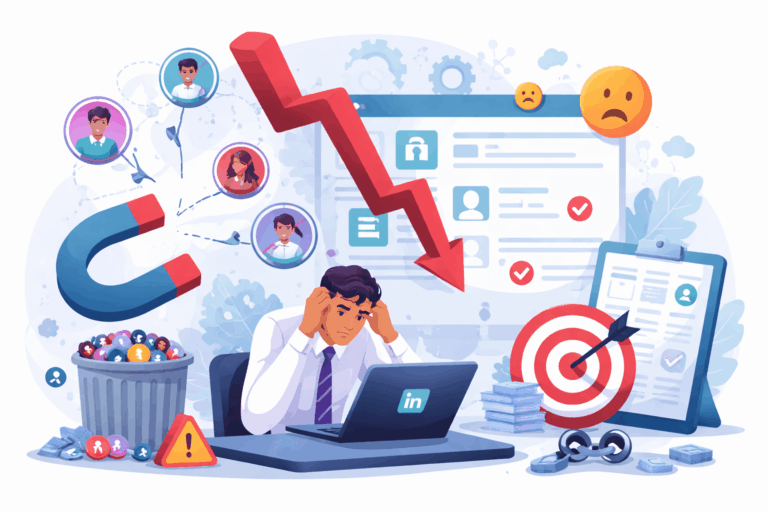
It usually fails when:
- Targeting is too broad
- Messaging is salesy
- Content lacks authority
- Sales & marketing operate separately
- Results aren’t reviewed weekly
Why Experienced Execution Matters
LinkedIn looks simple—but it’s not forgiving.
Without:
- Platform understanding
- B2B buyer psychology
- Funnel alignment
- Data interpretation
Budgets burn quietly.
Teams that succeed treat LinkedIn as:
- A revenue system
- Not an experiment
- Not a posting platform
- Not a “boosted post” channel
conclusion:
In 2025, LinkedIn remains the most powerful B2B lead generation channel because it aligns with how decisions are actually made today.
But success requires:
- Strategic patience
- Buyer empathy
- Execution discipline
- Continuous optimization
If you approach LinkedIn as a shortcut—you’ll lose money. If you approach it as a decision-engine—it becomes your strongest growth asset.


