
Table of Contents
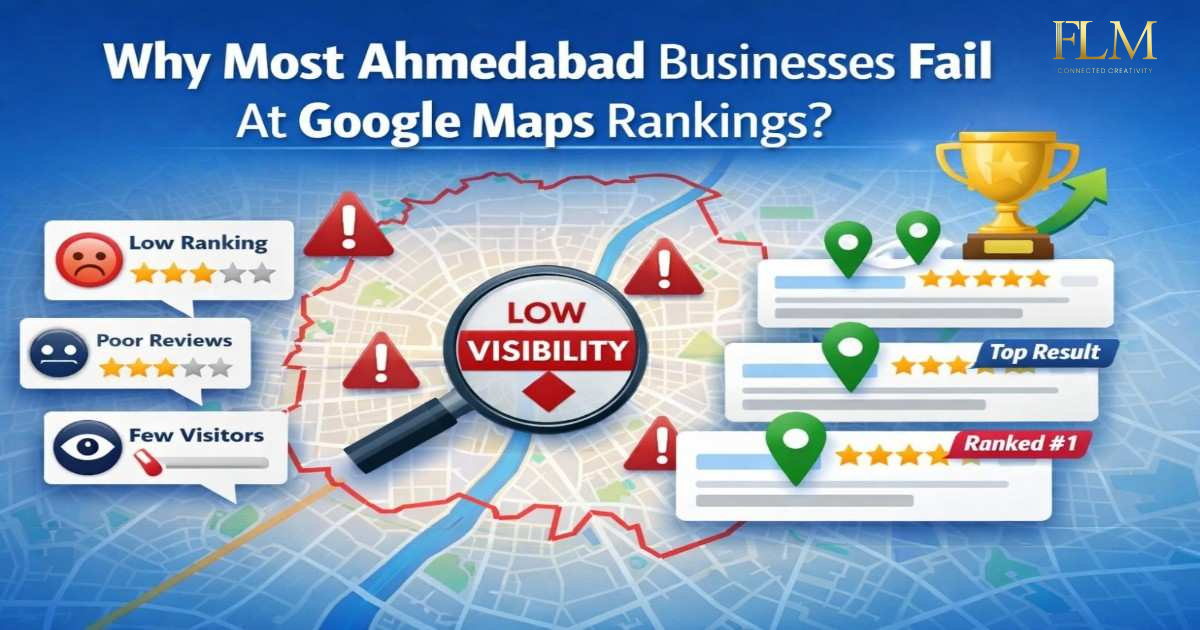
ToggleWhy Most Ahmedabad Businesses Fail At Google Maps Rankings?
Last year, I audited a service business in Ahmedabad that had spent over ₹1.2 lakh on “Local SEO” in 8 months.
Their frustration sounded familiar:
- “Our Google Business Profile is active”
- “We get thousands of views”
- “Agency says rankings dropped due to algorithm update”
- “But calls and walk-ins are almost zero”
When I opened their Google Maps presence, the problem was obvious — they were doing Local SEO, but not Local Business reality.
Most Google Maps blogs fail Ahmedabad businesses because they:
- Talk about rankings, not revenue
- Explain signals, not decisions
- Blame algorithms instead of wrong priorities
This guide is not here to sell you anything.
It’s here to give you clarity, reality, and uncomfortable truths — based on real audits of Ahmedabad businesses across services, clinics, real estate, trades, and local brands.
REAL BUSINESS PROBLEMS — GROUND REALITY IN AHMEDABAD
From my on-ground audits, these are the most common problems:
Fake Metrics That Don’t Pay Bills
Businesses celebrate:
- “10,000 profile views”
- “1,200 direction requests”
- “High discovery searches”
But can’t answer:
- How many calls?
- How many site visits?
- How much revenue?
Google Business Profile insights look impressive, but they are vanity metrics unless tied to leads.
Zero Agency Accountability
Common pattern:
- Monthly report = tool screenshots
- No call recordings
- No attribution
- No business outcome discussion
When results drop, the excuse is always:“Google updated something.”
No proof. No diagnosis.
Confusion Between Ads, SEO & Maps
Ahmedabad business owners are constantly misled:
- Google Ads ≠ Google Maps rankings
- Website SEO ≠ Local Pack visibility
- Posting on GBP ≠ ranking improvement
These channels support each other, but they are not substitutes.
Wrong Local SEO Priorities
I often see:
- Daily AI posts on Google Business Profile
- Fake keyword stuffing in business name
- Useless citations on random directories
While ignoring:
- Service clarity
- Proximity reality
- Review trust
- Call behavior
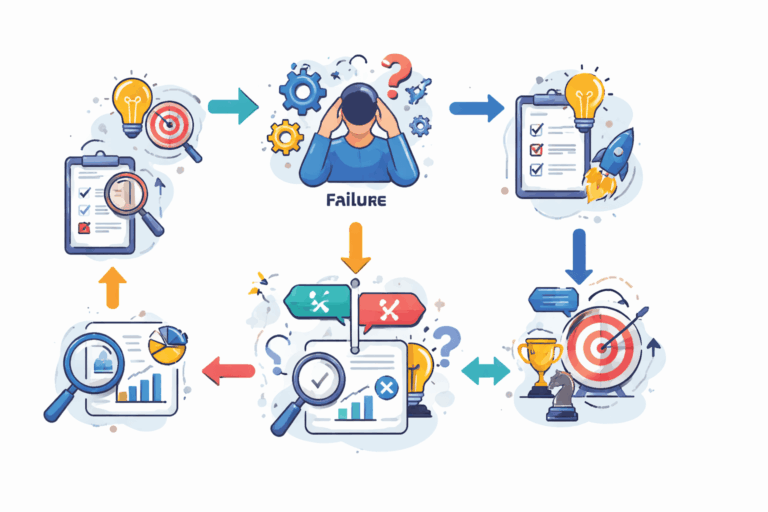
STEP-BY-STEP FAILURE & DECISION FRAMEWORK
Step 1: Local Business & Service Clarity
What businesses do wrong
Too Many Services Listed
When a business lists too many services, Google struggles to understand what the business is actually known for. The listing loses relevance for specific searches, and users feel confused about the core expertise. In Google Maps, focused service businesses perform better than those trying to cover everything. This lack of clarity directly reduces calls and genuine enquiries.
Vague Descriptions (“Best Services in Ahmedabad”)
Using generic phrases like “best services in Ahmedabad” adds no real value for Google or customers. The Ahmedabad-based digital marketing agency It doesn’t explain what problem the business solves or why someone should choose them. Such descriptions feel promotional rather than trustworthy, leading to lower engagement. Google Maps rewards clarity, not marketing slogans.
No Core Offering Focus
Without a clear core offering, a Google Maps listing sends mixed signals to both Google and potential customers. The business fails to align with specific local search intent, making rankings unstable or weak. Customers hesitate to contact businesses that don’t clearly communicate their main service. Over time, this results in wasted Local SEO effort with minimal business impact.
What actually matters
- One primary service
- One realistic service area
- Clear problem you solve
Why it affects Maps
Google Maps ranks relevant specialists, not generalists.
Pro audit insight
Many Ahmedabad businesses shouldn’t rank — because users don’t understand what they do.
Step 2: Google Business Profile Setup & Optimization
What goes wrong
Wrong Categories
Choosing the wrong primary or secondary categories is one of the fastest ways to kill Google Maps visibility. When categories don’t match the actual service offered, Google shows the listing for irrelevant searches or doesn’t show it at all. Even strong reviews and activity won’t compensate for incorrect categorization. For Ahmedabad businesses, this often means losing visibility to better-aligned competitors nearby.
Inconsistent Info
When business name, address, phone number, or service details differ across platforms, it creates trust issues for both Google and customers. Google Maps treats inconsistency as a reliability risk, which weakens ranking stability. Customers also lose confidence when details don’t match, leading to fewer calls and visits. Consistency is a basic requirement, not an advanced optimization.
No Conversion Intent
Many Google Business Profiles are set up to “exist” but not to convert. There is no clear call action, no service clarity, and no reason for a user to contact the business. Google tracks user behavior like clicks, calls, and direction requests, and weak engagement sends negative signals. Without conversion intent, visibility may appear, but real business results won’t follow.
What matters
- Correct primary category
- Service-specific descriptions
- Real photos (not stock)
Why it matters
Google trusts listings that behave like real businesses.
Step 3: Location Signals & Proximity Reality
Closer to the Searcher
Google Maps strongly favors businesses that are physically closer to the person searching. No amount of optimization can consistently override distance. Many Ahmedabad businesses waste money trying to rank city-wide when proximity is working against them. Understanding your realistic visibility radius saves time, budget, and false expectations.
Inside the Core Business Cluster
Certain areas in Ahmedabad naturally have dense clusters for specific services, and Google tends to trust these zones more. Businesses located inside these clusters often appear more frequently because users already expect those services there. Trying to outrank cluster-based competitors from outside the area is usually an uphill battle. Location context matters more than effort.
With Stronger Behavioral Signals
Businesses that receive more calls, clicks, direction requests, and engagement tend to stay visible longer on Google Maps. These behavioral signals tell Google that users prefer that listing. If users see your profile but don’t interact, rankings weaken over time. Google Maps rewards real user action, not just profile completeness.
Mistake
Trying to rank city-wide from a remote area.
Reality
Maps ≠ SEO.
Proximity beats effort.
Step 4: Reviews, Trust & User Behavior
What businesses do
- Chase review count
- Buy fake reviews
- Ignore replies
What works
- Consistent real reviews
- Service-specific mentions
- Natural response patterns
Why it matters
Reviews influence clicks, calls, and dwell time — not just stars.
Step 5: Website & Local SEO Connection
What matters:
Service Pages Tied to Local Intent
A generic service page rarely supports Google Maps visibility. What works is a clear service page that matches how local customers actually search, including area-based intent and real service descriptions. These pages help Google connect your website with your Google Maps listing. Without local intent, your website adds little support to Maps rankings.
Clear NAP Consistency
Name, Address, and Phone number consistency across your website, Google Business Profile, and directories builds trust with Google. Even small mismatches can weaken local signals and create ranking instability. Customers also lose confidence when contact details don’t match. NAP consistency is a foundation, not an advanced tactic.
Search Console Local Queries
Google Search Console shows the exact local searches your website appears for, revealing real demand and relevance. These queries help validate whether your services align with local intent. Ignoring this data means guessing what customers search for. Businesses that review local queries make better Local SEO decisions and avoid wasted effort.
Step 6: Tracking Calls, Leads & Real ROI
If you’re not tracking:
- Calls
- Form leads
- Direction-based visits
Then you don’t have a Local SEO strategy — you have hope of marketing.
Read More:- Why Brand Authority Matters More than Rankings?

REAL CASE STUDIES
Case Study 1: Small Local Service Business
- Industry: Home repair services
- Budget: ₹12,000/month
- Initial Position: Not in top 20
- Actions: Service focus, review cleanup, call tracking
- Result (9 months): Consistent top-5 visibility in nearby areas
- Lesson: Reduced services = better relevance
Case Study 2: Established Multi-Location Business
- Industry: Healthcare clinic
- Problem: One branch dominating, others invisible
- Fix: Location-specific reviews + page structure
- Outcome (12 months): Stable visibility in local radiuses
- Lesson: Maps doesn’t reward brand size — it rewards location trust

SOCIAL PROOF
“We stopped chasing rankings and started tracking calls. That changed everything.”
-Rajesh Patel — Founder, Local Services
“Earlier reports looked good. Now we know which branch actually gets patients.”
-Dr. Neha Shah — Marketing Head, Clinic
“Maps didn’t work until we accepted proximity limits.”
-Amit Desai — Partner, Real Estate Firm

VERIFIED DATA & LOCAL MARKET CONTEXT
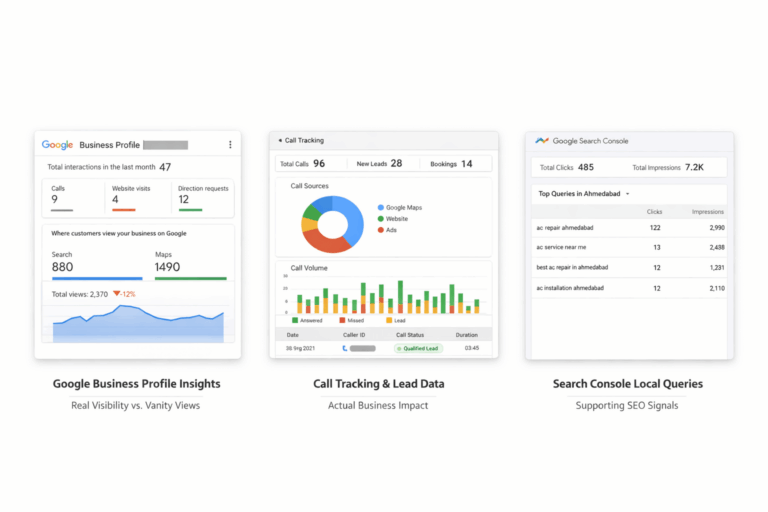
Google Business Profile Insights
Google Business Profile Insights show how often people view, click, call, or request directions from your listing. On their own, these numbers can be misleading, because high views don’t always mean real inquiries. The real value is comparing actions like calls and direction requests against visibility. This helps separate genuine demand from vanity exposure.
Google Search Console
Google Search Console reveals the exact local search terms that trigger your website in Google results. This data helps confirm whether your business is appearing for the right services and locations. If queries don’t match your core offering, Google Maps support will remain weak. Search Console is a reality check for local relevance.
Google Analytics
Google Analytics helps track what users do after clicking through from Google Maps or search results. It shows whether visitors actually engage, fill forms, or leave immediately. Low engagement often signals mismatched intent or weak service clarity. Analytics connects visibility to user behavior, not just traffic volume.
Real Call Tracking Dashboards
Call tracking dashboards show which calls came from Google Maps, website clicks, or ads — and which ones turned into real leads. This is where Local SEO becomes measurable and accountable. Without call tracking, businesses rely on assumptions instead of data. Real decisions require real call and lead evidence.
PROOFS & SCREENSHOT
Conclusion:
Google Maps failure isn’t about algorithms. It’s about misaligned expectations and wrong decisions.
Ask yourself:
- Do I know where my calls come from?
- Am I realistic about location?
- Is my service clarity strong?
- Do users trust me?
- Am I measuring revenue — or impressions?
If you can’t answer these, Maps isn’t your problem.
Why Most Ahmedabad Businesses Fail At Google Maps Rankings? : FAQs
Google Maps prioritizes proximity and user behavior like clicks and calls over service quality alone. If users engage more with a nearby listing, it will often rank higher. Quality helps retention, not initial visibility.
Google Maps builds long-term visibility and trust, but it takes time. Ads work faster when you need immediate demand. The right choice depends on urgency, budget, and patience.
Local SEO usually needs at least 6–9 months to show stable results. Anything faster is often temporary or misleading. Consistency matters more than speed.
If reports focus on impressions and rankings but avoid calls and leads, that’s a red flag. A credible agency shows clear attribution. No proof means no accountability.
Yes, sometimes stopping is the right decision, especially if location and proximity limit visibility. In such cases, ads or partnerships may deliver better ROI.


